Nov 04, 2026
Last Updated: November 3, 2026
Quick Summary
To start a craft beer distribution business, you buy beer from breweries and sell it on to pubs, bars and shops, handling storage, delivery and paperwork while earning a margin on every keg and case. You must secure HMRC Alcohol Wholesaler Registration Scheme approval, premises licensing, cold chain storage and a white delivery van before trading, and fund working capital to cover the gap between paying breweries and being paid by pubs.
Starting a craft beer distribution business means buying beer from breweries and selling it on to pubs, bars and shops, not to the public. For a benchmark, see how independent craft beer wholesalers midlands operate. You handle storage, delivery and paperwork.
That sounds simple. It isn't.
At Swallow Drinks, we have spent over 40 years in drinks wholesale. The hard part is cash flow, licensing and keeping the cold chain intact from brewery gate to cellar floor.
The work breaks into five areas:
Below, we walk through each one in the order you should tackle it. Get the order wrong and you will spend money before you have a licence to trade.
Starting out means covering five core areas, each of which has to be in place before the next one makes sense.
| Area | What it covers |
|---|---|
| Licensing and compliance | Approvals from HMRC and local authorities |
| Storage and transport | Keeping beer quality intact |
| Brewery relationships | Building a range that sells |
| Sales | Winning pubs and bars that pay on time |
| Cash flow | Surviving slow payers |
A craft beer distribution business plan is the document that tells you, and any lender, whether the numbers work before you commit capital. It should cover your range, your delivery area, your target accounts and a month-by-month cash forecast.
Most guides treat the plan as a funding formality. We disagree. The plan is where you find out that your margin per keg will not cover your fuel and driver costs on short routes, and it is far cheaper to learn that on paper than in month four.
Startup capital for a beer distributor goes into four pots: stock, storage, a vehicle and working capital. The last one is the one that sinks new businesses.
You will pay breweries before pubs pay you. That gap, your cash conversion cycle, is the real constraint. If a brewery gives you 14 days to pay and a pub takes 30 days to settle, every keg you sell ties up cash for roughly a fortnight.
List every cost before you start:
Then build the plan around three numbers, not one:
Watch out: new distributors routinely underfund working capital and then cannot restock in month three. Budget for it from day one, and stress-test the forecast against a scenario where your two biggest accounts pay a fortnight late.
Market research for a distributor is not a survey. It is a list of named pubs, bars and restaurants you can realistically supply, with the route between them mapped out.
Start with venues close together. Short routes mean more drops per hour and lower cost per drop.
Ask each target three questions before you pitch:
Then map the answers onto a simple grid: volume per week against distance from your warehouse. Accounts in the top-left, high volume, short distance, are your first calls.
If you are also running your own venue, the same planning discipline applies to choosing a supplier. Our trade ordering platform gives trade customers access to the range, register for trade supply to browse it.
You cannot legally trade as a wholesaler without the right approvals. In the UK, alcohol wholesale is regulated through HMRC's Alcohol Wholesaler Registration Scheme, alongside local licensing and premises requirements.
Alcohol wholesale in the UK is regulated through HMRC's Alcohol Wholesaler Registration Scheme.
Check the current requirements and approval process directly with HMRC's Alcohol Wholesaler Registration Scheme guidance before you spend money on stock.
You will also need:
Regulatory compliance is not a one-off task. It runs through every purchase and every sale.
Selling craft beer to pubs and bars comes down to reliability and range, not price alone. Landlords remember the supplier who turned up on a Friday when the lines ran dry.
SALT ALPACALYPSE IPA 4.3% 50LTR →
Build your pitch around three points:
Understanding the wider wholesale drinks market helps you pitch credibly. Our guide to wholesale drink distribution covers how the market is structured.
Then prove it. Offer a trial order, deliver on time, and follow up in person.
Beer distribution logistics is the part that decides whether your beer arrives in condition. Warm, shaken or badly stored beer tastes wrong, and the pub will blame you, not the brewery, not the driver, you.
Most guides stop at "keep it cool". The operational reality is more specific.
Storage comes first. Beer needs a cool, dark, stable environment. Temperature control protects flavour and shelf life, and the cold chain has to hold from the brewery gate all the way to the cellar floor, not just in the warehouse.
A cold room is not a luxury for a serious distributor. For a deeper guide to designing storage and cold chain operations, see bar supply chain logistics solutions. The practical points that matter:
Then the fleet. A white delivery van, racked out so kegs and cases do not shift in transit, is the standard starting point.
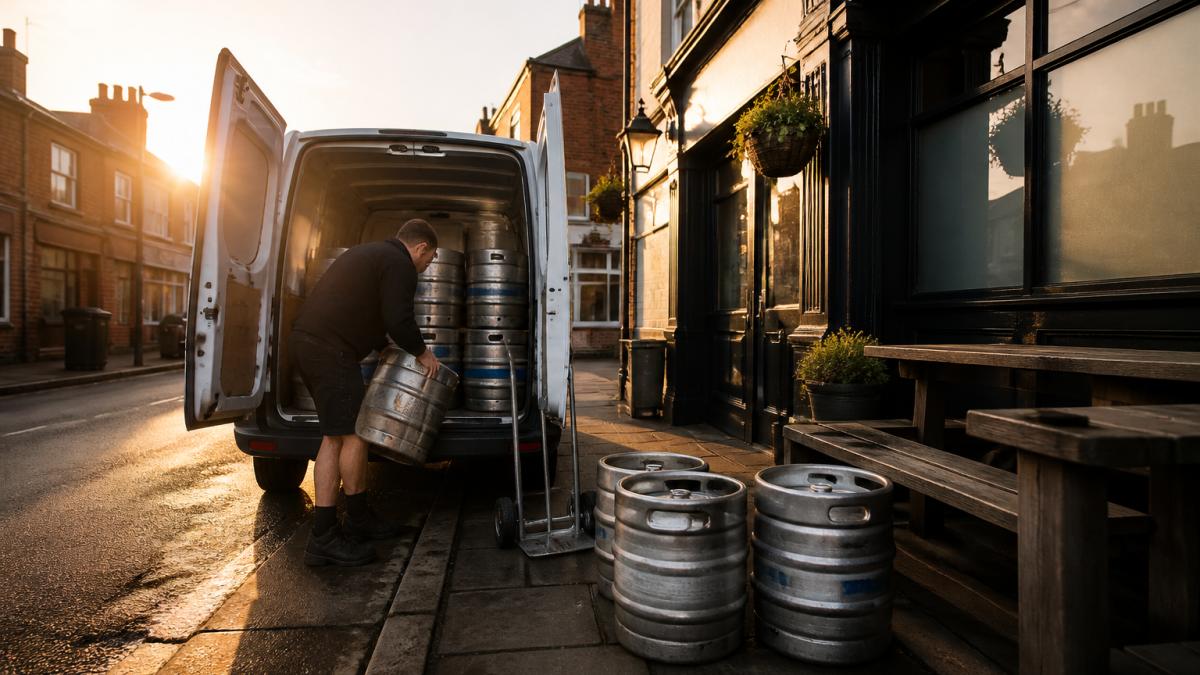
Route planning matters more than most new distributors expect. Readers planning their own operation can study bulk craft beer delivery services for practical detail to model their logistics. Group drops by area, fix delivery days, and keep a spare slot for emergencies.
A practical sequence for a new route:
Watch out: cheap vehicle cover that excludes kegs in transit is no cover at all, and a route that looks efficient on a map can lose money once loading and unloading time is counted.
Insurance is not optional. Product liability cover protects you if a customer claims a drink you supplied caused harm. Goods in transit cover protects stock between warehouse and cellar.
Speak to a broker who understands drinks wholesale.
Sourcing breweries is about balance. You need enough range to win accounts without tying up cash in slow-moving stock.
Start with a small core range and add depth where demand proves itself. Track stock turnover by line every month. If a beer sits for months, cut it.
A common mistake is chasing too many small breweries at once. Each one means another supplier relationship, another delivery to schedule and another set of terms. Our guide to sourcing niche craft beers explains how to build a range that sells.
For a sense of what a working portfolio looks like, our range includes lines such as Salt Alpacalypse IPA 4.3% 50LTR at £175.00, Salt Jute IPA 30LTR at £117.51 and Camden Pale Ale 4% 30LTR at £107.75.


If you are opening a pub, bar or restaurant, you need a supplier you can rely on. We have been Birmingham's number one wholesaler for over 40 years, and we supply wine, beer, spirits and soft drinks to the on-trade.
Here is what we offer trade customers:
Our trade ordering platform lets you browse the full range, check prices and place orders when it suits you. Register for trade supply to see the range and start ordering.
We also stock non-alcoholic drinks for venues building a fuller menu.
Starting a distribution business is hard work. Choosing the right supplier for your own venue should not be. Get started with Swallow Drinks to build your drinks range.
Alcohol wholesale in the UK is regulated through HMRC's Alcohol Wholesaler Registration Scheme. Check each requirement with your local authority before committing to a warehouse lease.
Margins depend on your route to market and how tightly you control costs. A distributor typically earns a percentage of the wholesale price, so profitability comes from stock turnover and route density rather than headline margin. Running full loads to clustered accounts keeps freight costs per keg low, while slow-moving lines tie up cash. Build a profitability analysis into your craft beer distribution business plan that models freight, storage and breakage, and review it monthly against actual sales forecasting.
Start with a short list of venues whose menu and customer base suit the beers you carry, then approach the licensee with a specific proposal: a tasting, a trial keg and a clear price. Show you understand their footfall and their existing range. Reliability wins accounts over time, which is why operators value six-day-a-week delivery and fast response when lines fail. Offering a mix of well-known craft labels and local options gives a publican a reason to switch.
At minimum you need temperature-controlled storage, keg handling equipment such as sack trucks and stillages, and a delivery vehicle suited to keg and case loads. Cold chain matters for cask and keg beer quality, so plan chill space before you sign a lease. A warehouse management system helps with SKU management and stock rotation. Many new distributors start by partnering with an established wholesaler to test demand before buying a fleet.
Members of:


AWRS Registration Number: XJAW00000100730