Nov 01, 2026
Last Updated: October 31, 2026
Quick Summary
To start a wine bar Birmingham operators must research the local market, write a lender-ready business plan, secure premises with correct planning use, and obtain a premises licence plus a personal licence from Birmingham City Council. Build a profitable wine list and choose a reliable drinks supplier before opening night.
Opening a wine bar Birmingham starts with knowing exactly who you are for. This guide from Swallow Drinks walks you through the seven steps to start a wine bar in Birmingham, from market research to your first delivered order.
A wine bar business plan is only as strong as the concept behind it. Before you look at a single premises, answer three questions:
Walk the areas you are considering on a Thursday, Friday and Saturday night. Count the footfall. Note which venues are full and which are empty. That field research beats any desk report.
Your concept drives everything that follows: your licence application, your fit-out budget, and your wine list.
Pick one and commit. Trying to be all three is the most common mistake we see in new operators.
A lender wants three things from your wine bar business plan: realistic numbers, a clear market, and evidence you understand your costs. Vague optimism gets rejected. Specific figures get funded.
Your plan needs these sections:
Build your forecast from the bottom up. Start with seats, then turns per session, then average spend. A 40-cover bar doing two turns a night at £25 a head is £2,000 a week before you count quiet Mondays.
Your break-even point is the weekly revenue that covers rent, wages, stock, utilities and finance. Know that number before you sign a lease.
Premises is where budgets go wrong. A site that looks perfect can hide problems that cost thousands to fix, and in a city with as many distinct drinking districts as Birmingham the location decision deserves more than a gut feel.
Walk each candidate area on a Thursday, Friday and Saturday night and record footfall, the mix of venues, and where queues form. Compare:
For each site, check transport links, nearby competition, the customer segment you would serve, and whether the rent and rates leave room for a realistic margin. Ask the council and local business improvement district for footfall data where available, and speak to neighbouring operators about trade patterns.
Confirm the premises has the correct planning use for a drinking establishment with the local planning authority before you sign. A change of use may need planning permission, and conditions can be attached on opening hours, noise, outdoor seating, deliveries and extraction. Planning and licensing are separate consents: passing one does not grant the other.
Get a survey and have a solicitor check the lease terms, including rent reviews, break clauses, dilapidations and any restrictions on use. A short delay now saves a long dispute later.
Once the site is secured, your drinks supplier becomes the next critical partner. Swallow Drinks has supplied the trade for over 40 years and can help you plan opening stock around your concept. Register at Swallow Drinks trade ordering to see live pricing.
Wine bar licence requirements in England centre on two documents: a premises licence and a personal licence. You cannot legally sell alcohol without them, and in Birmingham the application route runs through Birmingham City Council's licensing authority. Getting the sequence and paperwork right is the difference between opening on schedule and losing weeks to a returned application.
A premises licence authorises the sale of alcohol, regulated entertainment and late-night refreshment at a specific site (Licensing Act 2003 explained). Apply to Birmingham City Council before you open, and build in lead time: applications are subject to a consultation period, and complex or contested applications take longer. The application needs:
Advertise the application as the council requires (a notice at the premises and a notice in a local newspaper) and keep copies. If residents or responsible authorities make representations, the application can go to the licensing sub-committee, so talk to neighbours and the environmental health team early rather than late.
A personal licence is held by an individual who has passed an approved Level 2 Award for Personal Licence Holders course and obtained a basic criminal record check. The personal licence is issued by the council that received your application. Every premises that sells alcohol must name a designated premises supervisor (DPS) on the premises licence, and that person must hold a personal licence (Premises licence (England and Wales)).
SAN GIORGIO PINOT GRIGIO 12% 75CL (V) →
Licensing and planning are separate consents, and passing one does not grant the other. Confirm the premises has the correct planning use for a drinking establishment with the local planning authority before you exchange contracts. A change of use may need planning permission, and the council can attach conditions on noise, opening hours, outdoor seating and deliveries. Building control sign-off covers means of escape, fire alarms, emergency lighting, ventilation and accessible toilets.
Register the business, complete a written fire risk assessment, and put food safety procedures in place under food hygiene regulations if you serve food. Age verification is a legal duty: train every member of staff on Challenge 25 and keep a refusals log. Keep allergen information for any food or drink you serve.
Check the GOV.UK guidance on alcohol licensing for the current application process, and confirm fees, forms and timelines directly with Birmingham City Council before submitting. If you want a supplier who understands the licensing and stock side of opening, register at Swallow Drinks trade ordering.
Your wine list is your product and your biggest controllable cost. Get the economics right and the rest follows.
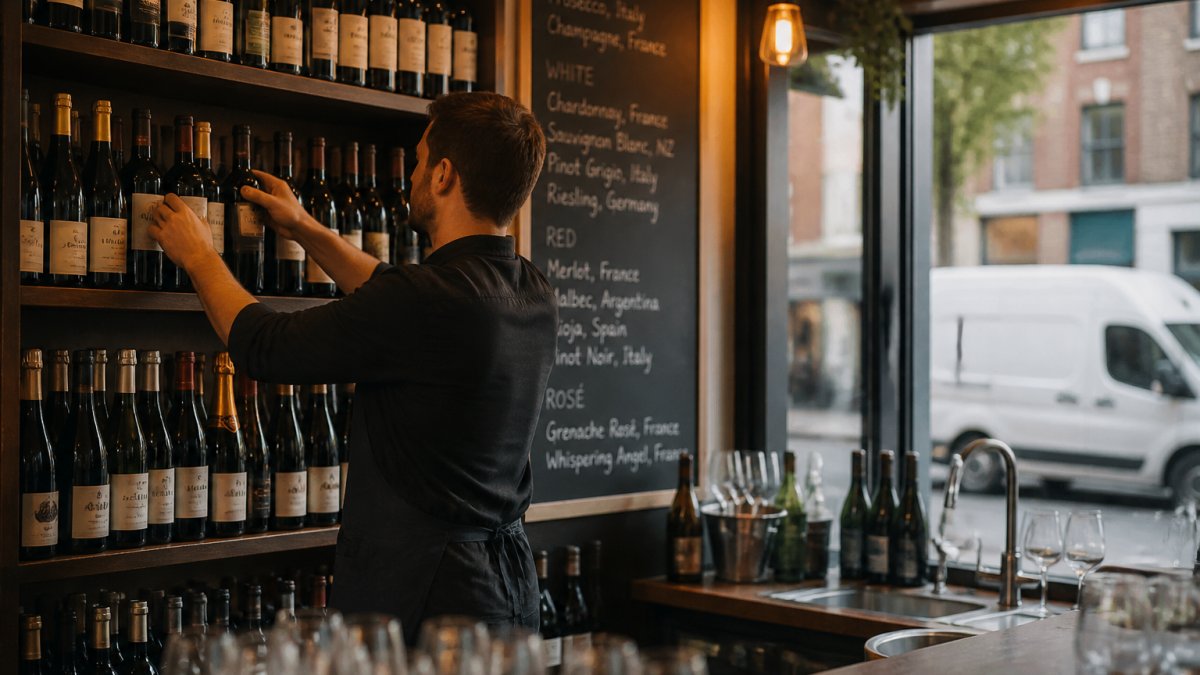
Aim for a sensible spread across your list:
Buy by the case to protect your margin. A San Giorgio Pinot Grigio 12% 75cl at £6.70 a bottle gives you a house white.
A Wenlock Spring Still 500ml flat cap PET line gives you a non-alcoholic option for drivers and non-drinkers.
Here is the list structure and the example lines the article uses to build a wine list.
| List tier | Role on the list | Example product |
|---|---|---|
| House wines | Volume sellers | San Giorgio Pinot Grigio 12% 75cl at £6.70 |
| House wines | Two reds, two whites, a rosé | Keep two reds, two whites and a rosé |
| Mid-range | Where most customers buy | Toro Fuerte Malbec 13% 75cl at £8.76 |
| Premium | Small selection for special occasions | Small selection for special occasions |
| Sparkling | Celebrations and by-the-glass | Prosecco for celebrations and by-the-glass service |
| Beer, spirits and soft drinks | Not every customer drinks wine | Wenlock Spring Still 500ml flat cap PET |
Knowing how to attract customers to a wine bar Birmingham starts before you open the doors. Build a crowd, then give them a reason to come back.
Your supplier is your most important partner after your landlord. Choose one that delivers reliably, prices transparently, and knows your menu.
Here is what to look for:
At Swallow Drinks, we have been Birmingham's independent drinks wholesaler for over 40 years. We are family-run.
Register for our trade area at Swallow Drinks trade ordering to see live pricing and place your first order.
Starting a wine bar in Birmingham is a sequence, not a sprint.
That last step matters more than most operators expect. A bar that runs dry on a Saturday night loses customers it never gets back.
At Swallow Drinks, we back new operators with over 40 years of trade experience, a full portfolio of premium wine, beer, spirits and soft drinks, and six-day-a-week delivery across the region.
Get started with Swallow Drinks and open your wine bar with a supplier that knows the trade as well as you do.
You need a premises licence from Birmingham City Council to sell alcohol, plus a personal licence for the designated premises supervisor. If you play recorded music or host live acts, plan for those activities on the same application. You must also register the business with HMRC, register as a food business if serving food, and arrange employers' liability insurance once you take on staff. Apply early, as the premises licence requires a consultation period before a decision.
That figure covers deposits, refurbishment, furniture, glassware, EPOS, initial drinks stock and a cash buffer. Build your own number from three quotes per item, add 15% contingency, and keep at least three months of operating costs in reserve. Lenders will want to see this breakdown in your wine bar business plan.
Start with a list of roughly 40 to 60 wines split by style and price tier, with a house pour at each colour and a few by-the-glass options that rotate. Add local craft beer, a short spirits range and non-alcoholic choices. Price for a healthy profit margin and track sales weekly so slow lines get replaced. A wholesale partner such as Swallow Drinks can help you build the list and keep deliveries consistent six days a week.
Run tutored tastings, by-the-glass flights and a changing chalkboard list so there is a reason to return. Partner with nearby restaurants and hotels for referrals, and use social media to show new arrivals. Keep your Google Business Profile accurate and collect reviews from the first week. Most importantly, train staff to recommend confidently: a customer who feels guided spends more and comes back. Track footfall and repeat visits monthly to see what works.
Members of:


AWRS Registration Number: XJAW00000100730