Nov 06, 2026
Last Updated: November 5, 2026
Quick Summary
Local supply chains improve craft beer quality by shortening the distance and time between field and fermenter, which preserves hop aroma, malt consistency and yeast viability. Shorter routes mean fewer handovers, lower spoilage risk and faster traceability when a batch goes wrong. They improve control, not certainty, since harvest variability and limited local ingredient range remain real trade-offs.
Craft beer volume fell 4% in the first half of 2026, according to the Brewers Association 2026 Midyear Report, yet breweries that shortened their supply routes are holding quality steadier than those buying on price alone. A local supply chain is the network of growers, maltsters, hop merchants and hauliers that moves brewing ingredients from field to fermenter within a short distance and a short timeframe. At Swallow Drinks, with 40 years in the trade, we have seen how supply routes shape what ends up in the glass. Below, we break down seven ways local supply chains affect the finished pint, including the trade-offs most guides skip.
Browse our beer and lager categories to see the range a local wholesaler can put behind your bar.
Local ingredients in craft beer change the finished pint because freshness, variety and handling are all decided closer to the brewery. The Technavio craft beer market analysis reports a 15% increase in local sourcing initiatives in 2026, driven largely by breweries wanting tighter control over ingredient condition.
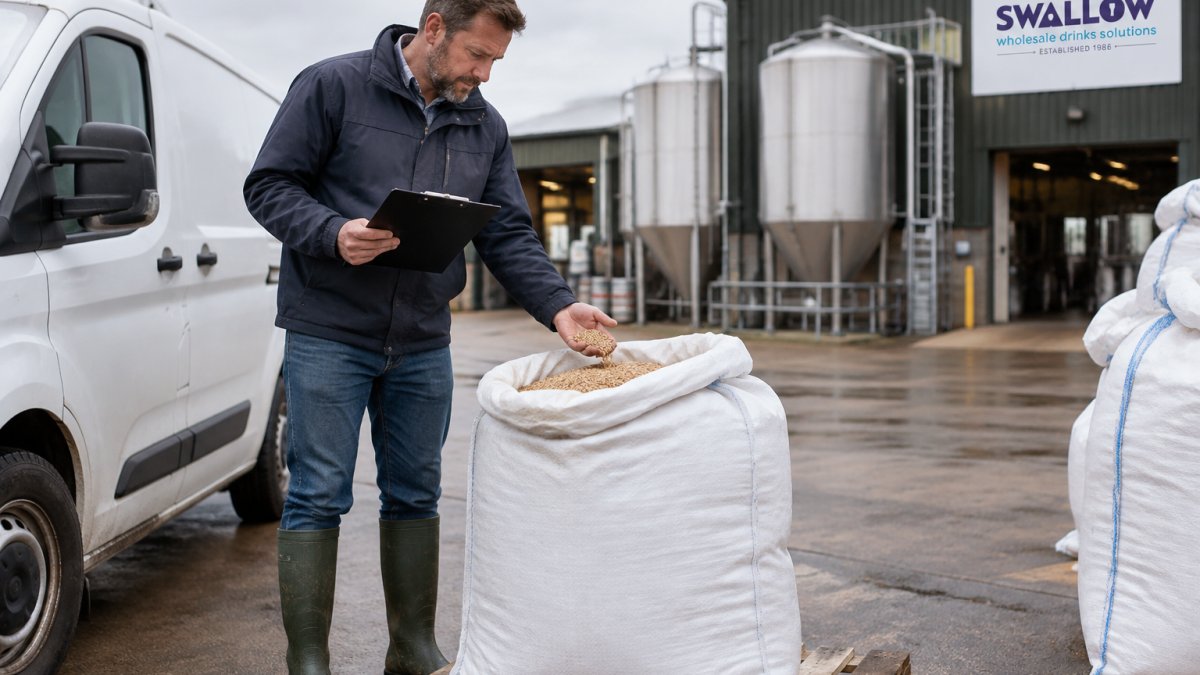
Malt and barley supply the sugars that become alcohol and the proteins that build body. Grain that travels badly can arrive with uneven moisture, which can show up as inconsistent extraction in the mash.
Local sourcing is not automatically better. Some brewing ingredients simply do not grow here, and a brewery that refuses to import will brew a narrower range. Harvest variability also hits harder when you rely on a handful of nearby farms: one poor season and your malt specification shifts. The honest position is that local supply chains improve control, not certainty.
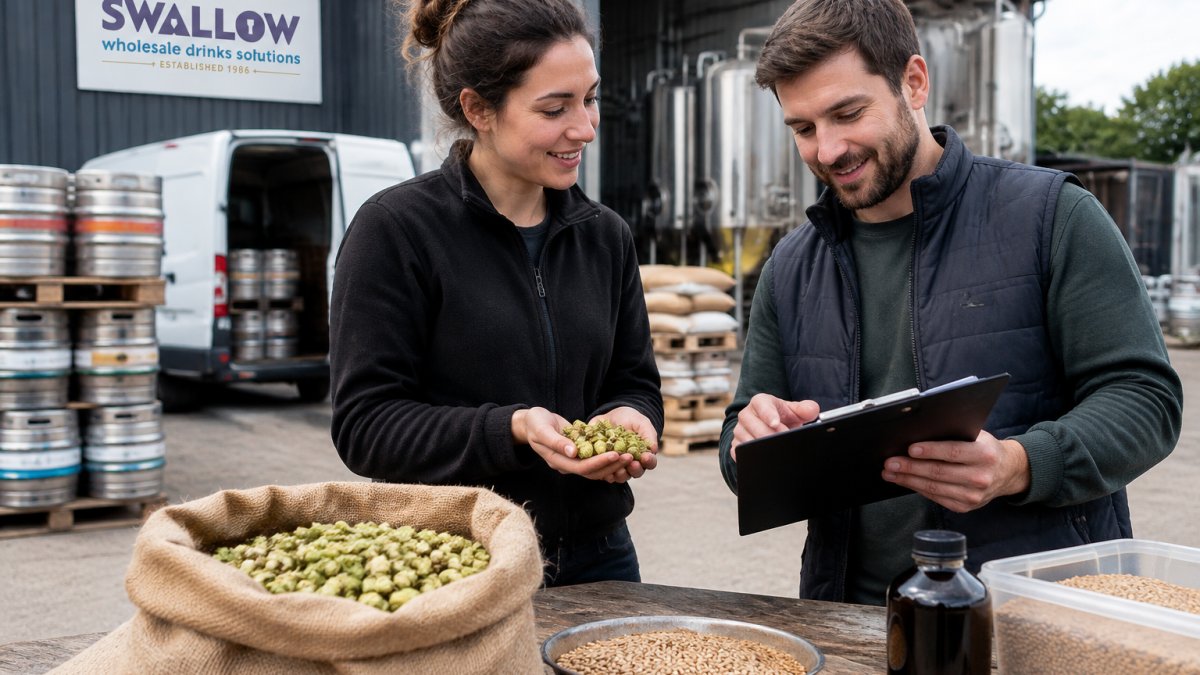
Fresh hops and beer flavour are directly linked because hop oils and aromatics degrade fastest of any brewing ingredient. Hops lose their punch within days of picking unless dried and stored cold, and every extra week in transit costs aroma. A brewery buying locally can brew within the harvest window and capture the green, resinous character that defines a fresh-hopped beer. The same principle applies to yeast: a short trip from lab to fermenter means a healthier pitch and a cleaner fermentation.
Beer ingredient traceability is the ability to follow any batch of malt, hops or yeast back to the field, harvest and supplier that produced it. Traceability matters commercially as well as technically: when a batch tastes wrong, a brewery with short, documented supply lines can isolate the cause in hours rather than weeks. Emerald Insight's framework for a sustainable craft beer supply chain notes that short distribution chains reduce spoilage risk precisely because fewer handovers mean fewer unknowns.
Transport and storage decide whether quality survives the journey. Long sea freight exposes ingredients to heat swings and humidity, and every additional warehouse is another chance for a pallet to sit too long. Brewer World's reporting on short distribution chains highlights how breweries are shortening routes specifically to cut spoilage. The same logic applies after packaging: a keg that reaches your cellar quickly, stored cool and undisturbed, pours better. Our guide to draught beer freshness and line care covers what to do once it lands.
OXFORD BREWERY BEARDED MEN LAGER 4.3% 50LTR →
Malt extract and moisture determine gravity and body; hop alpha-acid content determines bitterness; dissolved oxygen at packaging determines how long the beer stays fresh; and yeast viability determines fermentation cleanliness. A short chain helps because the supplier who knows your specification can flag a change before it ships, a maltster can tell you the new harvest is running two points lower on extract, and the brewer can adjust the grist rather than discover it in the fermenter.
Practical quality assurance follows a sequence most breweries find workable:
MDPI Sustainability Journal case study of Ishikawa Shuzo shows how local supply chain decisions improved operational stability, and the same discipline applies to brewing. For venues, the payoff is a keg that pours the same pint every time; our guide to draught beer freshness and line care covers what to do once it lands, and our keg range includes Oxford Brewery Bearded Men Lager 4.3% 50LTR at £165.00 and Camden Pale Ale 4% 30LTR at £107.75. Register for trade ordering to see the full range.


Local sourcing versus global supply chains is not a simple contest. Some ScienceDirect research on microbrewery sourcing points out that many small breweries keep global suppliers for ingredients unavailable locally, accepting longer routes for style range.
| Factor | Local Supply Chain | Global Supply Chain |
|---|---|---|
| Ingredient freshness | Higher, shorter transit | Depends on freight and storage |
| Style range | Limited to what grows nearby | Wider access to speciality ingredients |
| Spoilage risk | Lower, fewer handovers | Higher, more handling points |
| Traceability | Fast, direct to farm | Slower, multiple parties |
| Resilience to disruption | Stronger locally | Exposed to freight and border delays |
If local sourcing suits your venue, our guides to bulk craft beer delivery services and independent craft beer wholesalers in the Midlands explain what to look for. Our own keg range includes Oxford Brewery Bearded Men Lager 4.3% 50LTR at £165.00 and Camden Pale Ale 4% 30LTR at £107.75.
Running a bar on inconsistent beer is a slow leak you cannot afford. Swallow Drinks is a family-run independent wholesaler with 40 years in the trade, a vast portfolio of premium brands, and a delivery operation built for the on-trade across the region. Register for trade ordering and get access to our full range, including Hawkstone Premium Lager 4.8% 50LTR at £185.95 and Beavertown Neck Oil 4.3% 30LTR at £131.65. Read why local drinks partners matter for your business, then get started with Swallow Drinks and keep your lines pouring beer you can stand behind.

Shorter journeys mean less time between harvest, delivery and brewing, so ingredients arrive with more of their aroma and structure intact. Local supply chains also make batch problems easier to trace, because there are fewer handlers between the field and your cellar. The gain is real but not automatic: it depends on the brewery testing what arrives and rejecting what fails.
Not by itself. Malt quality depends on variety, growing conditions and how it was kilned, and harvest variability means two seasons from the same farm can perform differently. What local sourcing does deliver is fresher malt with a known history and a supplier you can phone when a batch behaves oddly. Breweries that adjust their grist and mash for each delivery get better consistency. Those that assume local equals better often find the opposite.
Hops lose aromatic oils quickly after harvest, and the decline accelerates with heat and oxygen exposure. Fresh hops and beer flavour are tightly linked: late and dry hopping with recently harvested hops gives brighter citrus and resin notes, while aged hops read as dull, cheesy or grassy. Whole cones deteriorate faster than pellets. That is why breweries using local hops often brew seasonally, and why a short supply chain matters most for the beers you sell on aroma.
Three stand out. Harvest variability means a local maltster cannot promise identical spec every season. Seasonality limits what is available, so some styles become impossible outside a window. Volume is the third: a small local supplier may not cover a full year of brewing. ScienceDirect research from 2025 notes some microbreweries keep global sourcing for ingredients they cannot get locally, accepting longer chains to protect the recipe. The practical answer is a mixed sourcing model with local as the base.
Members of:


AWRS Registration Number: XJAW00000100730