Nov 12, 2026
Last Updated: November 10, 2026
Quick Summary
Bar staff training is a structured programme covering pouring standards, licensing duties, responsible service and Challenge 25 age checks, delivered before the first shift and spread over the first fortnight. It replaces ad hoc on-the-job teaching, so every member of staff meets the same standard from day one.
Good bar staff training programmes for independent venues are the difference between a bar that runs smoothly on a Friday night and one that falls apart the moment a busy shift starts. At Swallow Drinks, we have supplied the on-trade across Birmingham and the West Midlands for over 40 years, and we have seen how much a consistent, well-taught team protects a venue's stock, its reputation and its takings.
Independent venues rarely have a dedicated training department. The owner or manager often teaches new starters on the job, between serving customers. That works until someone pours a measure incorrectly, mishandles a card payment or misses the signs of a customer who has had enough. A written, structured programme removes the guesswork.
A good programme does three things. It sets a standard for how drinks are poured, stored and served. It makes sure every member of staff understands their legal duties around alcohol. And it gives new starters a clear route from their first shift to working unsupervised.
Anyone selling alcohol in England and Wales works under the Licensing Act 2003, which sets out the conditions attached to a premises licence and the offences that apply to staff (Licensing Act 2003). Venues in Scotland work under their own licensing legislation. Your premises licence or personal licence conditions are the starting point for your training, and your local licensing authority is the body to check if you are unsure what applies to your site.
The most important duty for bar staff is refusing service to anyone who is already drunk, or who is likely to become drunk. Staff should also know how to check identity and when to refuse a sale, and they should understand the basics of how to record a refusal or an incident.
Responsible service of alcohol is the practice of serving drinks in a way that protects customers and the public. In practice this means spotting signs of intoxication early, offering water or food, and knowing when to stop serving.
Challenge 25 is the widely used age-verification policy that asks anyone who looks under 25 to show photo ID before they buy alcohol. A common mistake is letting staff rely on appearance alone. Train your team to ask for ID whenever there is doubt, and to accept only the forms of identification your policy lists. Keep a log of refusals, because it protects both your staff and your licence if an inspector visits.
Before a new member of staff pulls a single pint, they should have covered the basics. Use this checklist as a starting point and tailor it to your venue:
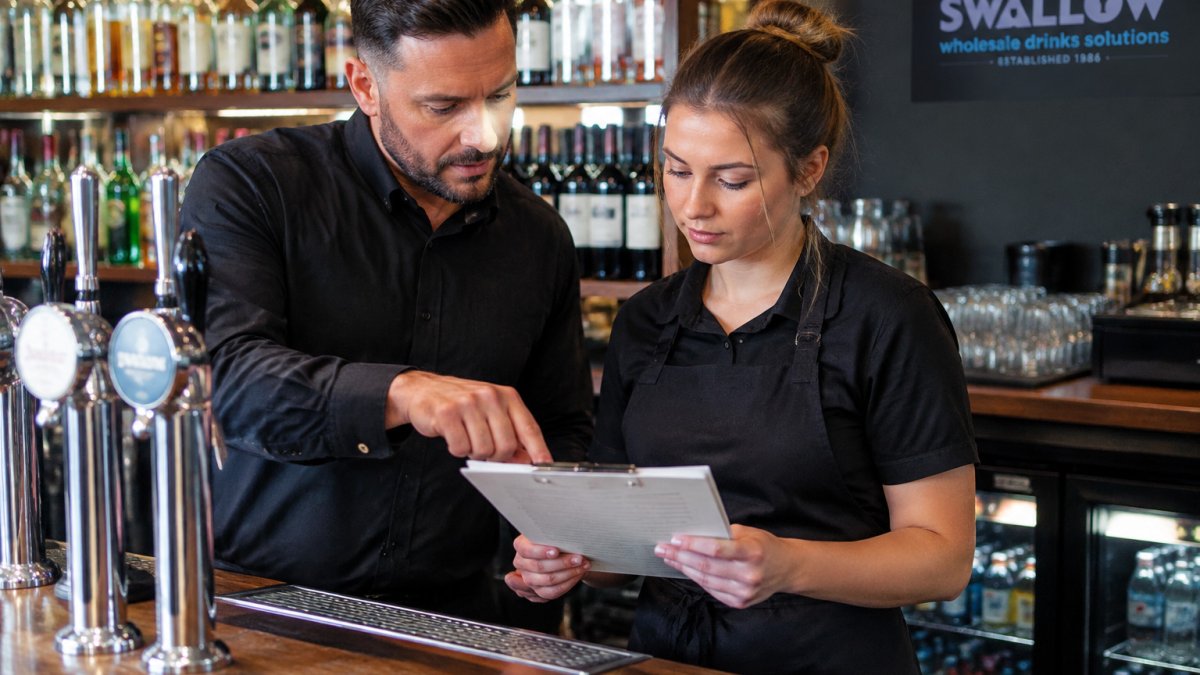
Walk through the checklist with the new starter and have them sign it off. A printed version pinned behind the bar is useful as a reference during the first few weeks.
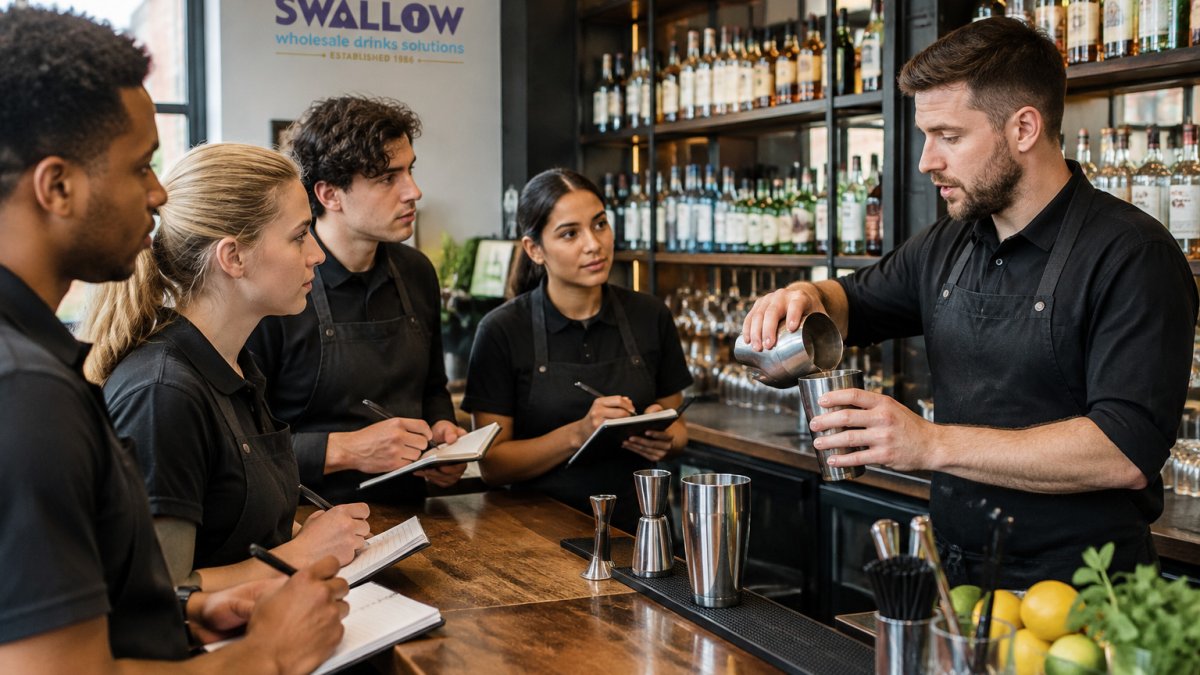
A typical induction for a bar role takes between two and five days of structured training, spread over the first fortnight, rather than one long session. Shorter, spaced sessions help new starters retain what they learn. Most of the first shift should be shadowing an experienced member of staff, with the new starter taking on tasks gradually.
Shadowing works best when the trainer knows what they are checking. Set specific goals for each shift, such as pouring twenty measures correctly or completing a full cash-up, and confirm they are met before moving on.
Upselling is one of the easiest ways to lift the average spend per customer, but it only works when it feels helpful. Staff who push products tend to lose the custom they were trying to win. Instead, teach them to make a specific, relevant suggestion.
A useful approach is to recommend a pairing or an alternative rather than a more expensive version of the same drink. Staff who know the range can say, "If you like that gin, our bartender recommends this tonic," or offer a low- or no-alcohol option to a guest who is driving. Keeping a good range of low and non-alcoholic drinks on hand, such as the options available in our low and non-alcoholic drinks range, gives staff more choices to suggest.
Train staff to read the table. A group that is celebrating may welcome a bottle of prosecco, while a quiet couple may want a second glass of wine. The aim is to match the suggestion to the customer.
The article sets out a few practical ways staff can suggest drinks without pushing, and the table below summarises them.
Approach | Example from the article | Why it works |
|---|---|---|
Recommend a pairing | Suggest a bartender's tonic with a gin | Feels helpful, not pushy |
Offer an alternative | Suggest a low- or no-alcohol option to a guest who is driving | Meets the customer's real need |
Match the table | Prosecco for a celebrating group, a second glass for a quiet couple | Suggestion fits the customer |
Every bar eventually faces an aggressive customer, and the way a member of staff responds in the first thirty seconds usually decides whether the situation settles or escalates.
Start with body position. Staff should approach the customer from the side rather than head-on, keep their hands visible and open, and stand at an arm's length or more. Standing behind the bar with a clear route to a colleague or an exit gives them room to step back without losing face.
Next, the language. A simple structure works well: acknowledge the feeling, state the boundary, and offer an alternative. For example, "I can see you're frustrated that the kitchen's closed.
Teach a clear escalation path. Decide in advance who takes over if a conversation is not working, when to ask a colleague to step in, and when to call the police.
Watch out: a refusal delivered in front of a group often hardens the customer's position, so where possible move the conversation to a quieter spot near the bar's end without making it look like a removal.
After any incident, hold a short debrief within the same shift if you can. Record what happened in your incident log, note what worked, and check in with the member of staff involved. Bar work is demanding, and repeated confrontations can leave staff anxious or disengaged long before they say so.
A well-trained, supported team is also easier to hold to the standards in the rest of this programme. If your staff trust that management will back them when a customer turns difficult, they are more likely to refuse service early and log the refusal, which protects both the team and your premises licence.
You can build these scenarios into your training using the same stock and set-up your team works with every day, which helps the lessons carry over to a real Friday night. Trade customers registered through our trade ordering portal can also access the product information they need to brief new staff accurately on what they are serving.
Training and stock planning are usually handled by different people in an independent venue, and that gap is where many problems start. A member of staff trained to recommend a particular gin or a seasonal cocktail is of little use if the bottle is not on the shelf on the night. Planning the two together keeps the programme grounded in what you actually sell.
Start by listing the drinks your team will be expected to recommend or prepare in the next three months, including any seasonal serves and low- and non-alcoholic options. Then check each one against your current stock and your supplier's lead times. Swallow stocks a wide range of drinks for the on-trade, so you can usually fill the gaps from one place. It still helps to order the new lines a week or two before the first training session so staff can taste and handle them.
When you order, keep the product range close to what your training covers. If you are teaching a standard pour for a particular spirit, make sure the measures, glassware and garnishes are in place before the session. Registered businesses can manage this through our trade ordering portal, where stock and reorders can be kept in one place.
Measuring whether the training has worked is the step most guides leave out, yet it is what tells you whether to keep the programme as it is. Choose two or three simple measures before the programme starts.
Watch out: a rise in refusals after training is often a good sign, showing staff are following the policy, rather than evidence that customers are being turned away unfairly. Look at the pattern before drawing a conclusion.
Review the programme every quarter. Ask staff which parts of the checklist they used most and which they found unclear, and update the written materials behind the bar accordingly.
To put this into practice, book your first training session, align your stock order with the drinks your team will be serving, and register for a trade account to keep both in one place.
In England and Wales, the Licensing Act 2003 requires a designated premises supervisor and a personal licence holder for the sale of alcohol, but it does not set a single mandatory training course for every member of bar staff. Venues are still expected to ensure staff understand the licensing conditions, the challenge 25 policy and their duty not to serve people who are already drunk. Keeping a written record of who has been trained, and when, is the simplest way to show you have met those duties.
No. A personal licence is needed by the person who authorises alcohol sales on a premises, typically the designated premises supervisor or a manager. Other bar staff can serve alcohol without one, provided a licence holder authorises the sale and the staff are supervised. Your training programme should make clear which roles need a personal licence and which only need the in-house training on responsible service.
Start with a written checklist covering licensing conditions, till and cellar procedures, draught line cleaning and your house drinks menu. Pair each new member with an experienced colleague for their first few shifts, then review progress at one week and one month. Short, repeated practical sessions work better than one long classroom day, and a simple sign-off sheet makes it clear when someone is ready to work alone.
Swallow Drinks supplies drinks, bar supplies and gas to independent venues across Birmingham and the wider West Midlands, so your team learns the products they will actually pour and serve. Our trade ordering service at https://webtrade.swallow.uk.com/ lets you register your venue and manage stock, and our team can help you match your range to your menu. Non-alcoholic options are also available at https://www.swallow.uk.com/products.php?prd=low-and-non-alcoholic.
Members of:


AWRS Registration Number: XJAW00000100730