Oct 24, 2026
Last Updated: October 23, 2026
Quick Summary
To manage wholesale drink orders for tournaments, build a written order template, forecast demand per session rather than by total attendance, and confirm your order with the supplier at least five working days before the fixture. Keep the range short, check fast-moving lines at the halfway point of each session, and reconcile every event so the next forecast starts from real numbers.
Running a tournament bar without a written order template is how stockouts happen. A tournament drinks order template is a single sheet recording every product, pack size, quantity, delivery date and cost for one fixture. At Swallow Drinks, we have supplied on-trade venues for over 40 years, and the operators who order well all work from one.
A working template holds eight fields per line, or you will chase information on match day.
Add a second tab for deposits and returnable containers. Glass bottle lines need it.
Forecasting drinks demand for events starts with attendance, not habit.
Three inputs drive the number:
Work in cases, not bottles. A 24 x 500ml PET case is easier to count, stack and reconcile than loose units, and it matches how your supplier delivers.
NHS guidance on staying hydrated is worth keeping in mind for outdoor summer fixtures. Water and soft drinks sell hard when temperatures climb.
A tournament is a schedule of fixtures with different crowds, dwell times and drinking patterns. Forecast each session against the schedule, not the day as a whole.
Build your forecast around these drivers:
A common pattern is to over-order for the headline fixture and under-order for the quieter sessions around it. The quieter sessions are where stockouts actually happen, because nobody is watching them.
Split the day into sessions and forecast each one separately. Morning sessions are usually quieter. Evening sessions run longer and carry more soft drinks and mixers.
Use this method:
A worked example: if a session expects 300 people and your records show roughly one and a half drinks per head, that is 450 drinks. At 24 units per case, that is 19 cases, rounded up to 20 with buffer.
For a multi-day tournament, repeat the calculation for each session and add the totals. Then convert to delivery units:
Every forecast needs a safety margin, sized to how confident you are in the numbers and how bad a stockout would be.
A practical approach:
If you order through a trade account, check whether your supplier offers a mid-event top-up window. A morning-of-day-two delivery is often cheaper than running dry on day one.
Product range decides your margin as much as your stock levels do. A tournament needs a short, fast-moving core list plus a small premium tier. You can also browse our snacks categories to pair with drinks orders for the tournament.
Build the core around four categories:
For quantity planning, the DIET COKE CANS 330ML case is a popular line. If you want variety beyond cola, consider options like LUCOZADE SPORT ORANGE 500ML or LUCOZADE SPORT RASPBERRY 500ML.


Placing wholesale drink orders early is the difference between a calm build-up and a frantic Friday.
What to send with every order:
Ask two questions before you confirm: what is the cut-off for changes, and what happens if a line is short? A supplier who answers both clearly is worth keeping.
Registering for a trade account speeds this up. Trade customers can place repeat orders online rather than rebuilding the sheet each time, which removes a whole category of copy errors.
Event drinks stock management on the day is about visibility, not volume. Staff cannot sell what they cannot see, and you cannot reorder what you cannot count.
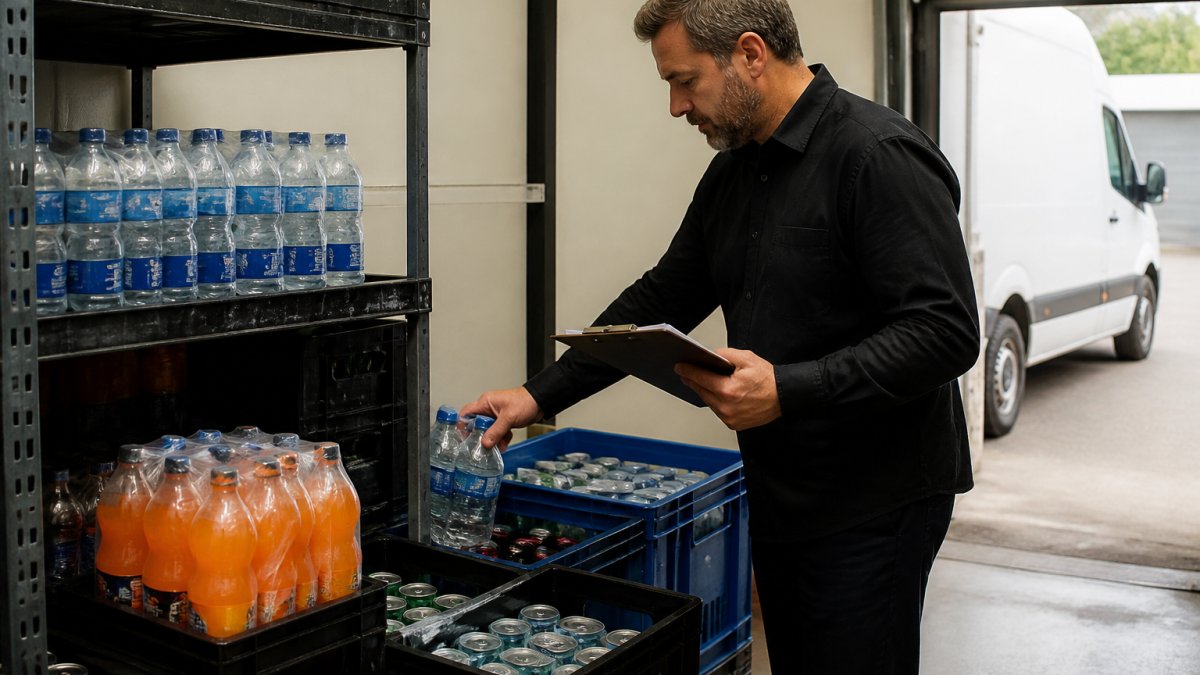
Set up three zones: front bar, back-up stock and overflow. Count the front bar at the start of each session and top up from back-up. Keep overflow sealed until you need it.
Simple rules that hold up under pressure:
A tournament day has a rhythm, and stock management should follow it. Build a simple check schedule around the fixture list:
For multi-day tournaments, the end-of-day count is the input to the next morning's top-up order. Without it, day two starts on guesswork.
Stockouts rarely happen because the order was too small. They happen because nobody noticed the line running down until it was empty.
A practical prevention routine:
If a line does run out, log the time and the session. That single data point is worth more than a guess when you forecast the next fixture.
The order template from Step 1 is not just a purchasing document. It is the control sheet for the day.
Keep it at the bar, not in the office. Mark off cases as they are opened, note any line that hits its trigger, and record any shortfall or substitution.
If you order through a trade account, the template also makes repeat ordering faster. Trade customers can place repeat orders online using the same line structure, which reduces the chance of a copy error on match day.
Drinks delivery planning for tournaments comes down to timing and access. Book the delivery for the day before the fixture, not the morning of it.
Check three things before the van arrives:
Count against the delivery note as it comes off the vehicle, not afterwards. Discrepancies are far easier to resolve on the spot.
For multi-day tournaments, split deliveries where possible. A mid-event top-up on the morning of day two protects you if day one runs hotter than forecast.
Reconciliation is the step almost everyone skips, and it is the one that makes the next tournament cheaper.
Run the numbers within 48 hours, while the event is fresh:
| Check | What to compare | What it tells you |
|---|---|---|
| Sales vs forecast | Units sold against your session forecast | Whether your drinks-per-head figure was right |
| Wastage | Opened but unsold, or damaged stock | Where handling or chilling needs work |
| Returns | Unopened cases and deposit containers | What can go back to the supplier |
| Cost per head | Total drinks spend divided by attendance | Your true drinks cost for the fixture |
Leftover sealed stock goes back into general bar stock if the date code allows.
That feedback loop is the whole point. Each tournament makes the next order tighter.
Tournament ordering rewards preparation over guesswork. Build the template, forecast by session, keep the range short, and reconcile every event.
Start with your expected attendance and the number of sessions, then apply a per-head estimate for each drink category. A typical working figure is two to three drinks per person per session, adjusted for weather and kick-off times. Check last year's sales leads and reorder rates if you have them. Build in a 10% buffer for finals and peak periods so you do not run dry at the busiest moment.
Place the main wholesale drink order at least two weeks before the tournament so your supplier can confirm stock and schedule delivery. Add a top-up order for the week of the event once ticket sales or team entries give you a firmer number. For multi-day fixtures, split deliveries so chilled stock arrives fresh rather than sitting in a warm store. Confirm the delivery window in writing and keep a named contact on both sides in case the schedule shifts.
Set a par level for each product and check stock levels at the end of every session rather than once a day. Keep a contingency reserve of water, canned soft drinks and a house lager that you do not touch until the final day. Have a named back-up supplier and a small emergency order ready to go. Recording reorder rates after each tournament shows you which lines sell out first, so next year's order template is tighter.
Count everything against your order sheet on the day after the event and log the difference as waste, staff use or returns. Unopened, in-date cases can usually go back into your normal stock for the venue's day-to-day trade, which protects your margins. Anything opened or short-dated should be moved to promotional pricing rather than left to expire. Feed the leftover figures back into your demand forecasting so the next event order is more accurate.
Members of:


AWRS Registration Number: XJAW00000100730