Nov 02, 2026
Quick Summary
Premium mixers that suit craft cocktails include Fever-Tree tonics, soda, ginger ale, ginger beer and lemonade, which Swallow Drinks stocks. Choose the mixer to match the base spirit, such as a standard or light tonic for gin and ginger beer for dark rum. Mixer choice shapes balance and cost per serve.
Premium mixers are the quiet workhorse of a good craft cocktail. Swallow Drinks, a family-run independent wholesaler with over 40 years in the trade, supplies bars and pubs across the West Midlands. Choosing the right mixer changes how a drink tastes, how it is balanced and how much it costs to serve, so the decision deserves more thought than it usually gets. Browse the premium beer options to see what you can order alongside your mixers.
Mixers do more than dilute a spirit. The carbonation lifts aromatics, the sweetness and acidity shape the finish, and the bitterness or spice can either support a gin or overpower a delicate vodka.
A craft cocktail is only as good as its weakest ingredient. When the spirit is well chosen but the mixer is flat, overly sweet or artificial, the whole drink falls apart.
Market data points the same way. The global cocktail mixers market was valued at US$12.7 billion in 2025 and is forecast to reach US$21.7 billion by 2033 (Grand View Research, 2026) (Cocktail Mixers Market Size And Share Report, 2026-2033). That growth reflects how many operators now treat the mixer as a deliberate menu decision, not an afterthought. Grand View Research cocktail mixers market forecast
There is a counterpoint worth taking seriously. Some experienced drinkers prefer simple fresh ingredients such as lemon, lime, ginger beer and simple syrup. A premium bottled mixer is a convenience and a consistency tool, and it does not replace fresh juice where a bar's style calls for it. The right answer depends on the drink, the volume and the staff behind the bar.
For most on-trade venues, a short core list covers the majority of orders. Focus on a few reliable tonics, a soda, a ginger option and one or two cordials or lemonades, then add specialist lines as the menu demands.
Tonic water is the most-ordered mixer behind a gin, and it is also where premium quality shows most clearly. Tonic water had the highest revenue share of the cocktail mixers market in 2022 (DataM Intelligence, 2022). DataM Intelligence cocktail mixers market analysis
Swallow Drinks stocks Fever-Tree in three styles, so you can match the tonic to the spirit and the customer:
Soda water is the simplest mixer and the one where bubble quality matters most. Fever-Tree Soda Water 24 x 200ml is available at £21.36 per case.


For ginger, the choice depends on the drink. Ginger ale suits lighter, sweeter serves, while ginger beer gives the bite a Moscow Mule or Dark and Stormy needs. Fever-Tree Ginger Ale 24 x 200ml is £17.98 per case, and Fever-Tree Ginger Beer 24 x 200ml is £18.00 per case.
Lemonade and elderflower open up a different family of drinks, from Pimm's-style long drinks to fresh, floral spritzes. Fever-Tree Lemonade 24 x 200ml is £17.98 per case, and Fever-Tree Elderflower 24 x 200ml is £19.86 per case.
For a cordial rather than a ready-to-serve mixer, Bottlegreen Elderflower Cordial 50cl is £7.14 and gives the bartender control over sweetness and dilution.
The best mixer depends on the base spirit, and the fastest way to get consistent results behind the bar is to work from a pairing matrix rather than guess. Match intensity to intensity: a bold gin can carry a bitter, botanical tonic, while a subtle vodka usually needs something neutral and clean. The table below sets out the spirit, the cocktail, the mixer to reach for from the Swallow Drinks range, the usual ratio and the garnish that finishes the drink.
| Spirit | Cocktail | Mixer | Ratio (spirit:mixer) | Garnish |
|---|---|---|---|---|
| Gin | Classic gin and tonic | Fever-Tree Tonic | 1:2 to 1:3 | Lime wedge or grapefruit peel |
| Gin | Light gin and tonic | Fever-Tree Light Tonic | 1:3 | Cucumber ribbon |
| Gin | Floral highball | Fever-Tree Elderflower | 1:3 | Lemon twist |
| Vodka | Vodka soda | Fever-Tree Soda Water | 1:3 | Lime wedge |
| Vodka | Vodka lemonade | Fever-Tree Lemonade | 1:3 | Lemon wheel |
| Whisky | Whisky highball | Fever-Tree Soda Water | 1:2 to 1:3 | Lemon peel |
| Whisky | Whisky ginger | Fever-Tree Ginger Ale | 1:3 | Orange peel |
| Dark rum | Dark and Stormy | Fever-Tree Ginger Beer | 1:3 | Lime wedge |
| Dark rum | Rum and ginger | Crabbies Ginger Beer 3.4% | 1:3 | Lime wedge |
A few practical notes sit behind that matrix. For gin, standard or Med tonic suits classic botanicals, while ginger ale or elderflower gives a lighter, floral twist. For vodka, soda water or light tonic keeps the spirit clean, and lemonade works for fruit-led serves. For whisky, ginger ale or ginger beer complements oak and spice, and soda water suits a simple highball. For rum, ginger beer is the classic partner for dark rum, and the lower-strength Crabbies option lets you keep the ginger character while dialling back the alcohol.
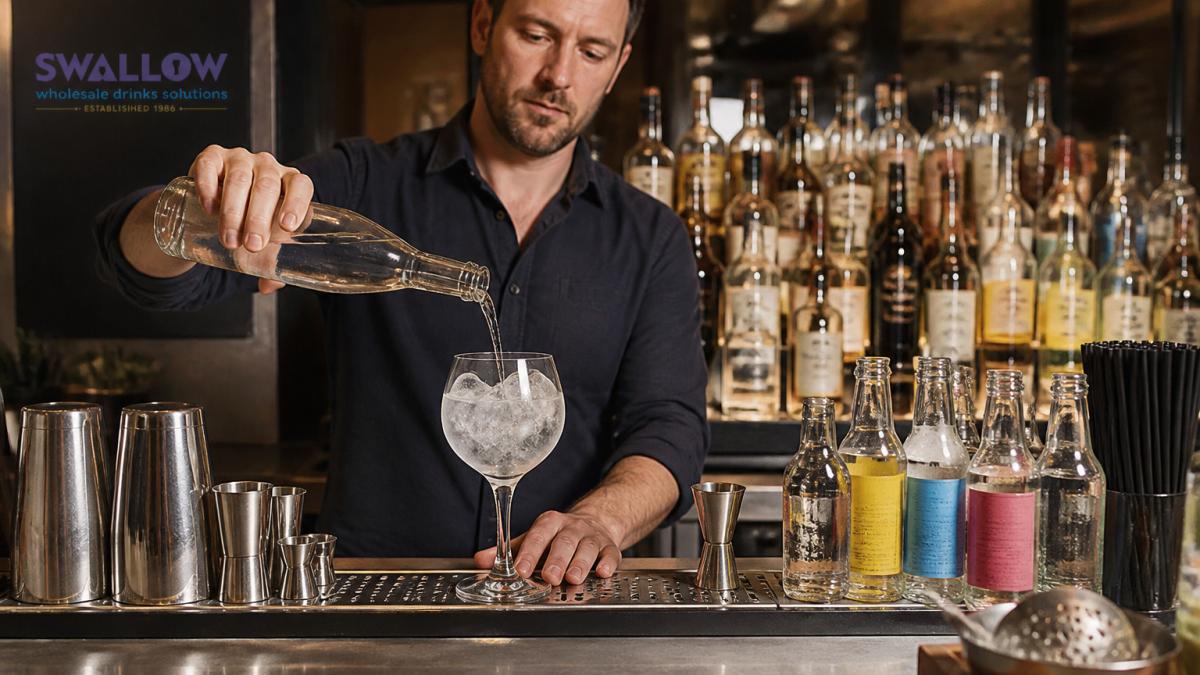
!Bartender pouring a gin and tonic over ice in a busy independent bar, with premium mixer bottles lined up on the back bar
Ratios are a starting point, not a rule. A stronger tonic or ginger beer may need less mixer to avoid masking the spirit, and a delicate vodka will be swamped by a heavy pour. Taste the first serve of any new combination before it goes on the menu, then write the ratio on the spec sheet so every bartender makes it the same way.
For bars that want speed over control,
If you are building a cocktail list around these pairings, Swallow Drinks stocks the full range of Fever-Tree mixers alongside the ginger beers and cordials above, so a single order covers every row of the matrix. Trade customers can register at webtrade.swallow.uk.com to set up an account and check current availability.
Balance comes from the ratio of spirit, mixer and any acid or sweetener. A typical long drink uses roughly one part spirit to three parts mixer, but the right ratio depends on the strength of both ingredients. A stronger tonic or ginger beer may need less mixer to avoid masking the spirit.
Carbonation matters too. Open fresh bottles just before service, and keep them cold. Flat mixers lose the lift that makes a highball refreshing, and warm mixers taste sweeter than they are.
Cost per serve is the figure that matters for a bar's margins, and it is the number most mixer roundups never publish. The method is simple: divide the case price by the number of bottles, then divide again by the number of drinks each bottle makes at your chosen ratio. The worked examples below use the case prices in this article and a 200ml bottle, which at a 1:3 ratio makes roughly one long drink once ice and garnish are accounted for.
| Mixer | Case price | Price per bottle | Approx. drinks per case | Approx. mixer cost per drink |
|---|---|---|---|---|
| Fever-Tree Tonic 24 x 200ml | £17.98 | Under 75p | 24 | Under 75p |
| Fever-Tree Light Tonic 24 x 200ml | £17.11 | Under 72p | 24 | Under 72p |
| Fever-Tree Med Tonic 24 x 200ml | £17.98 | Under 75p | 24 | Under 75p |
| Fever-Tree Soda Water 24 x 200ml | £21.36 | Under 89p | 24 | Under 89p |
| Fever-Tree Ginger Ale 24 x 200ml | £17.98 | Under 75p | 24 | Under 75p |
| Fever-Tree Ginger Beer 24 x 200ml | £18.00 | 75p | 24 | 75p |
| Fever-Tree Lemonade 24 x 200ml | £17.98 | Under 75p | 24 | Under 75p |
| Fever-Tree Elderflower 24 x 200ml | £19.86 | Under 83p | 24 | Under 83p |
Those figures are the mixer cost only. They exclude the spirit, ice, garnish, glassware and staff time, so treat them as the floor of the drink's cost rather than the whole picture. Even so, the comparison is useful: the gap between the cheapest and most expensive tonic in the range is a few pence per drink, which is rarely the difference between a profitable cocktail and a loss-making one. The spirit and the pour size move the margin far more than the mixer choice does.
Pack size should follow sales volume. A case of 24 suits a busy venue that goes through a mixer quickly, while smaller formats reduce the risk of waste on slower nights. Check shelf life on delivery, and rotate stock so the oldest bottles go out first. Opened mixers lose carbonation quickly, so keep them cold and use them within a day or two of opening rather than holding part-full bottles behind the bar.
Cordials work differently. Bottlegreen Elderflower Cordial 50cl at £7.14 is diluted to taste rather than poured neat, so the cost per drink depends on the dilution the bartender chooses. That gives more control over sweetness and cost, but it also adds a step to service and a variable that has to be trained in. For high-volume venues, the ready-to-serve bottles are usually the simpler route; for signature drinks where the dilution is part of the recipe, a cordial earns its place.
The practical takeaway is to cost the mixer per drink, not per case. A case price tells you what you spend; the per-drink figure tells you what you earn. Trade customers can register at webtrade.swallow.uk.com to set up an account.
For a bar, pub or restaurant in the West Midlands, the practical step is to build a short core list and order it on a schedule that matches your trade. Swallow Drinks supplies wine, beer, spirits and soft drinks, so one order can cover much of the bar.
To set up trade ordering and access your account, register at webtrade.swallow.uk.com. Swallow Drinks has been in business for 40 years.
Last Updated: November 1, 2026
A well-stocked bar typically keeps a standard tonic water, a light tonic, soda water, ginger beer and a ginger ale, plus a lemonade and an elderflower option for seasonal serves. Stocking a small range of these covers most gin, vodka, rum and whisky serves without tying up cash in slow-moving lines.
Gin pairs best with a crisp tonic water such as Fever-Tree Tonic, while vodka works well with soda water or lemonade for a cleaner profile. Rum suits ginger beer and ginger ale, and whisky is often served with soda water or a lighter ginger ale. Matching the mixer's flavour intensity to the spirit keeps the drink balanced rather than masking the base.
Tonic water contains quinine and added sweetness, giving it a distinct bitter edge that defines drinks like the gin and tonic. Soda water is plain carbonated water with no sweetness or bitterness, so it adds lift without changing the flavour of the spirit. Choose tonic when you want the mixer to be part of the flavour, and soda when the spirit should lead.
Start with the spirit and the flavour you want the finished drink to carry, then pick a mixer that complements rather than competes. Consider sweetness, acidity and carbonation level, and test a small batch before committing to a full menu. Premium mixers made with real fruit and botanicals tend to give more consistent flavour across a busy service.
Members of:


AWRS Registration Number: XJAW00000100730