
Aug 19, 2026
Last Updated: August 19, 2026
Menu engineering for bars is the strategic process of analysing your drinks list through the lens of profitability and popularity to optimise pricing, placement, and selection. Rather than treating your menu as a static document, you're actively managing which drinks stay, which go, and how they're positioned to drive both customer satisfaction and revenue.
At Swallow Drinks, we've worked with independent bar operators across the region for over 40 years, and we've seen firsthand how a poorly engineered menu leaves money on the table. The difference between a menu that simply lists your stock and one that's been engineered for profit is often 15-25% in gross margin improvement. This isn't about cutting corners on quality, it's about understanding which premium spirits, wines, and beers actually move profitably and which ones sit gathering dust.
The core of menu engineering rests on two metrics: popularity (how often a drink sells) and profitability (how much margin each drink generates). Most bar owners focus on one or the other. The ones who engineer their menus effectively balance both, using data to make decisions rather than guesswork or supplier relationships.
Popularity without profitability is a trap that catches many bar managers. A drink might sell consistently, but if your cost of goods sold is too high, those sales erode your margins. Conversely, a highly profitable drink that nobody orders is dead stock taking up valuable shelf space and capital.
When you categorise your menu items, you'll find that your bestsellers aren't always your profit drivers. A house vodka might sell 40 times a week but generate only 35% margin. A premium gin might sell 8 times a week but deliver 52% margin. Both matter, but they matter differently.
Sales velocity, how quickly a drink moves through your stock, is equally critical. Slow-moving premium spirits tie up cash that could be deployed elsewhere. Fast movers, even at lower margins, generate turnover that compounds. This is why seasonal rotation becomes essential. Your menu isn't just a list of what you serve, it's a financial instrument.
Calculating gross profit margin for each drink is straightforward, but many bar operators skip this step because they assume all spirits and wines generate similar returns. They don't.
Start with the cost of goods sold (COGS). This is what you paid for the bottle, divided by the number of standard pours you can extract. For a 70cl bottle of gin at £21.70, if you pour 25ml measures, you'll get approximately 28 pours per bottle. That's roughly 77p per pour in COGS.
Now determine your selling price. If you're selling that gin and tonic for £8.50, your gross profit per drink is £7.73. Your margin percentage is (7.73 ÷ 8.50) × 100 = 90.9%. That's strong. But compare it to a house vodka: if you're paying £12.41 per 70cl bottle and selling 25ml pours at £6.50, your COGS is 44p and your margin is 93.2%. Higher margin, but lower absolute profit per drink because your selling price is lower.
Create a simple spreadsheet with these columns: drink name, bottle cost, pours per bottle, cost per pour, selling price, margin percentage, weekly sales volume. Once you have this data, you can rank drinks by profitability and identify which ones are worth promoting versus which ones should be reconsidered.
The menu matrix framework divides your drinks into four categories based on popularity and profitability, giving you a clear strategy for each group.
Stars are your high-popularity, high-profitability drinks. These are the cocktails and spirits that sell frequently and generate strong margins. They deserve prominent placement on your menu, staff upselling, and consistent stock. Protect these drinks at all costs.
Plowhorses are high-popularity but lower-profitability items. They drive traffic and customer satisfaction but don't generate strong margins. You need these for customer retention, but they shouldn't dominate your menu real estate. Consider whether you can gently nudge customers toward higher-margin alternatives without losing the sale entirely.
Puzzles are low-popularity but high-profitability drinks. These might be premium wines, craft spirits, or specialty liqueurs that deliver excellent margins when they do sell, but sales are inconsistent. The puzzle is whether to invest in promoting them or accept that they're niche items. Some puzzles become stars with the right positioning or staff training.
Dogs are low-popularity and low-profitability. These are the drinks taking up shelf space and capital without delivering results. They're candidates for removal, though occasionally a dog serves a strategic purpose. Be intentional about keeping dogs, don't keep them by default.
Once you've categorised your entire menu, your strategy becomes clearer. Expand stars, protect plowhorses, investigate puzzles, and eliminate dogs.
Your menu's physical layout and visual hierarchy directly influence what customers order. The top right corner of a menu is the "premium zone." Customers' eyes naturally drift there first, and they associate items in that position with being special or recommended. Place your highest-margin items and signature cocktails there.
Grouping matters as well. Organise by spirit type (gins, vodkas, rums) or by drink category (cocktails, wines, beers) depending on your customer base. Independent bars often benefit from organising by experience: "Classic Cocktails," "House Specials," "Premium Spirits," "Wines by Region."

Descriptions matter enormously. A spirit listed as "House Vodka, 25ml" sells differently than "House Vodka Kalinska, smooth and clean, perfect for a classic martini, 25ml." The second version provides context and suggests a use case, which increases perceived value. Reserve detailed descriptions for items you're actively promoting or for premium offerings.
White space is your friend. A cramped menu feels chaotic and discourages reading. A menu with breathing room feels curated and premium. For digital menus, the same principles apply but with added flexibility. Ensure your highest-margin items are featured prominently in the interface.
Pricing psychology isn't about deception, it's about understanding how customers perceive value and making conscious decisions about how to present your prices.
Charm pricing (ending prices in .99 or .95) works for lower-priced items like house spirits but can feel cheap for premium offerings. Match your pricing psychology to your positioning.
Price anchoring influences perception. If your menu leads with premium spirits at higher price points, customers anchor to that price point. A house spirit then feels like exceptional value. Strategic placement of anchor prices shapes perceived value across your entire menu.
Bundling and pairing increase average transaction value. Offering a wine and spirit pairing at a slight discount to individual pricing encourages customers to spend more overall. Transparency in pricing builds trust and prevents customer frustration. If you're adding a service charge or premium for particular glassware, state it clearly.
Your wine list represents a significant opportunity for margin and customer experience. Unlike spirits, where house options dominate, wine allows for range and curation that differentiates your venue.
Start with a core range that remains consistent year-round. This typically includes 3-5 house wines (red, white, rosé, sparkling), 2-3 premium wines by the glass, and a curated selection by the bottle. Your house selections should deliver solid margin and broad appeal.
Seasonal rotation keeps your menu fresh and allows you to stock items with natural demand curves. In winter, heavier reds and fortified wines perform better. Summer brings demand for lighter whites, rosés, and sparkling wines. Rather than carrying the same wine list year-round, rotate 30-40% of your selection seasonally. This reduces dead stock, creates novelty, and allows you to test new producers and price points.
Partnering with a reliable supplier like Swallow Drinks ensures consistent access to quality wines and seasonal options. With over 40 years of experience supplying independent venues, we understand seasonal demand and can help you curate selections that work for your specific customer base.
When building your wine list, follow the 80/20 principle: 80% of your wine sales come from 20% of your selections. Identify those core performers and protect them. The remaining 20% of your list can be more experimental, testing new regions, producers, or price points.
Sales data is the foundation of effective menu engineering. Without it, you're making decisions based on intuition rather than performance.
Track these metrics for each drink: weekly sales volume, average selling price, COGS, gross profit per unit, total weekly profit, and stock turnover rate. Most point-of-sale systems can generate these reports automatically. If yours can't, a simple spreadsheet tracking will suffice.
Review this data monthly. Identify trends: which drinks are accelerating, which are declining, which are consistently underperforming. A drink with declining sales might indicate changing customer preferences, or it might indicate poor placement or staff unfamiliarity. Investigate before deciding to remove it.
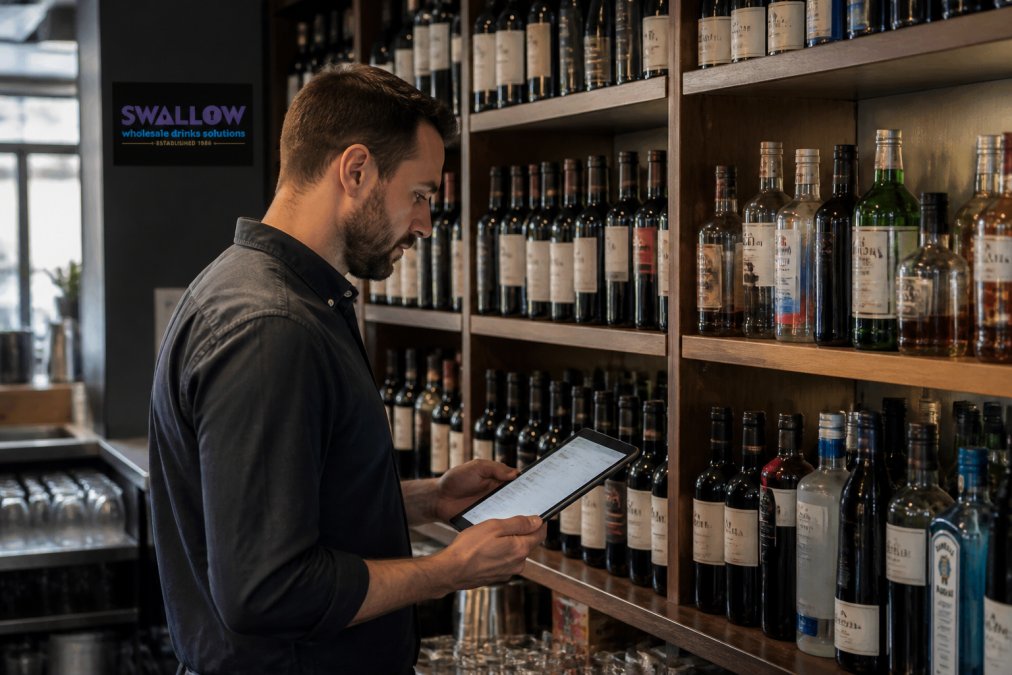
Stock control directly impacts profitability. Slow-moving stock ties up capital and risks obsolescence. Fast-moving stock generates cash flow and reduces spoilage risk. Aim for stock turnover of 6-8 times annually for spirits and wines, roughly every 6-8 weeks for a full rotation.
Use data to inform your supplier orders. Rather than ordering based on what's "always been popular," order based on current sales velocity. If a spirit sold 30 units last month but only 18 this month, reduce your next order accordingly.
Many bar owners benefit from working with a supplier who understands their business. Swallow Drinks provides not just stock but guidance on what's moving, what's seasonal, and what might work for your specific venue. Our team has analysed trends across independent bars and can recommend selections based on your sales data and customer profile.
Consider implementing a simple stock management system. A spreadsheet tracking par levels (the amount you want to maintain at all times) for each item, updated weekly, is often sufficient. This prevents both stockouts and overstock situations.
For independent bar operators looking to simplify this process, Swallow Drinks' trade ordering platform at Swallow Drinks Trade allows you to track your orders, manage par levels, and access sales insights alongside your ordering. This integration of supplier and stock management simplifies the process considerably.
Menu engineering transforms how you think about your drinks list. Rather than viewing it as a static catalogue, you're managing it as a dynamic financial instrument that balances customer satisfaction with profitability. The framework of popularity versus profitability, the categorisation of drinks into stars and dogs, and the disciplined use of sales data create a system where every item on your menu earns its place.
For independent bar operators seeking a partner who understands this approach, Swallow Drinks combines over 40 years of industry experience with a commitment to helping venues build menus that work. Our team can advise on which products deliver both customer appeal and margin, ensure consistent stock through reliable delivery, and support your menu engineering through our trade ordering platform. Get started by exploring our range of premium spirits, wines, and beers, and register with our trade area at Swallow Drinks Trade to access ordering tools designed specifically for independent venues.
Menu engineering for bars aims to maximize profitability by analyzing which drinks generate the highest gross profit and customer demand. The goal is to strategically position, price, and promote drinks so that your menu drives revenue growth. By understanding both sales velocity and contribution margin, you can make data-driven decisions about which items deserve prime placement on your menu and which deserve repositioning or removal.
Gross profit margin is calculated by dividing the gross profit (selling price minus cost of goods sold) by the selling price, then multiplying by 100. For example, if a spirit costs £5 and you sell it for £12, your gross profit is £7. Divide £7 by £12 and multiply by 100 to get 58% margin. Track pour costs and wholesale prices carefully, working with a reliable supplier like Swallow Drinks ensures transparent pricing so your margin calculations stay accurate.
Review your menu performance quarterly, or monthly if you're making significant changes. Seasonal shifts in customer preferences mean what worked in summer may not work in winter. Track sales velocity and profitability metrics regularly using your point-of-sale data. This allows you to rotate seasonal cocktails, adjust pricing, and remove underperforming items before they drain profit. Regular reviews also help you identify opportunities to upsell premium drinks and cross-sell complementary items.
Psychological pricing influences how customers perceive value and make purchasing decisions. Prices ending in .99 or .95 feel lower than rounded numbers, while strategic placement of premium items anchors customer expectations upward. Menu descriptions using evocative language, 'hand-crafted', 'small-batch', 'locally sourced', justify higher prices and increase perceived value. Grouping drinks by category and price point guides customers toward higher-margin items naturally, without aggressive upselling that damages the customer experience.
Key metrics include contribution margin (selling price minus cost of goods sold), pour cost percentage (total cost of drinks served divided by total drinks revenue), sales velocity (how quickly items sell), and gross profit per item. Track which drinks generate the highest absolute profit and which have the best margins. Use these metrics to identify your stars (high profit, high sales), plowhorses (high sales, low profit), puzzles (high profit, low sales), and dogs (low profit, low sales) so you can optimize placement and pricing accordingly.
Start by analysing your customer base and location. A neighbourhood gastropub will stock differently than a nightclub. Use sales data from your point-of-sale system to identify what customers actually order, not what you think they should order. Partner with a supplier like Swallow Drinks who understands the on-trade sector and can advise on curated selections that balance popular items with higher-margin drinks. Register on the trade ordering platform at webtrade.swallow.uk.com/ to access product recommendations and stock management tools designed for independent venues.
Members of:


AWRS Registration Number: XJAW00000100730