Aug 07, 2026
Last Updated: August 7, 2026
Drink cost percentage is the ratio of what you spend on drinks to what you earn from selling them. It's calculated by dividing your cost of goods sold (COGS) by your total drink revenue, then multiplying by 100 to get a percentage. For most hospitality venues, this single metric determines whether your drinks operation is profitable or bleeding money.
A bar manager at a high-volume nightclub in Birmingham might think they're thriving with strong sales, but if their drink cost percentage has crept up to 45%, they're leaving money on the table. Understanding and controlling this percentage is the difference between a venue that survives and one that scales.
At Swallow Drinks, we've worked with independent pubs, gastropubs, and hotel groups across the West Midlands for over 40 years. We've seen venues transform their profitability by focusing on this one metric. The venues that track it monthly don't just cut costs, they make smarter purchasing decisions, reduce waste, and build better relationships with suppliers.
Drink cost percentage varies dramatically by drink category. Spirits typically run 20-28%, draught beer sits around 25-30%, bottled beer ranges from 20-28%, and wine can span anywhere from 35-50% depending on your portfolio mix. Soft drinks and non-alcoholic options often carry lower percentages (15-25%) because the wholesale cost is lower relative to the retail price.
The industry average for mixed-use venues sits around 28-32% across all drink types combined. A gastropub in the West Midlands serving curated wines and craft beers might comfortably operate at 35-38% because their guests expect premium selection. A high-volume nightclub might target 22-26% because volume and speed matter more than margin per unit.
Your venue type fundamentally shapes your drink cost percentage target. A boutique hotel group serving premium drinks will have different economics than an independent bar competing on value. Restaurants with food-focused operations often accept higher drink cost percentages (32-38%) because drinks are secondary to food margins. Nightclubs with high volume typically run leaner (20-26%) because they move volume at tight margins.
Don't benchmark against the industry average. Benchmark against venues similar to yours. If you're a regional hotel group in the West Midlands, your target should match other boutique hotels in your area, not a chain nightclub in London.
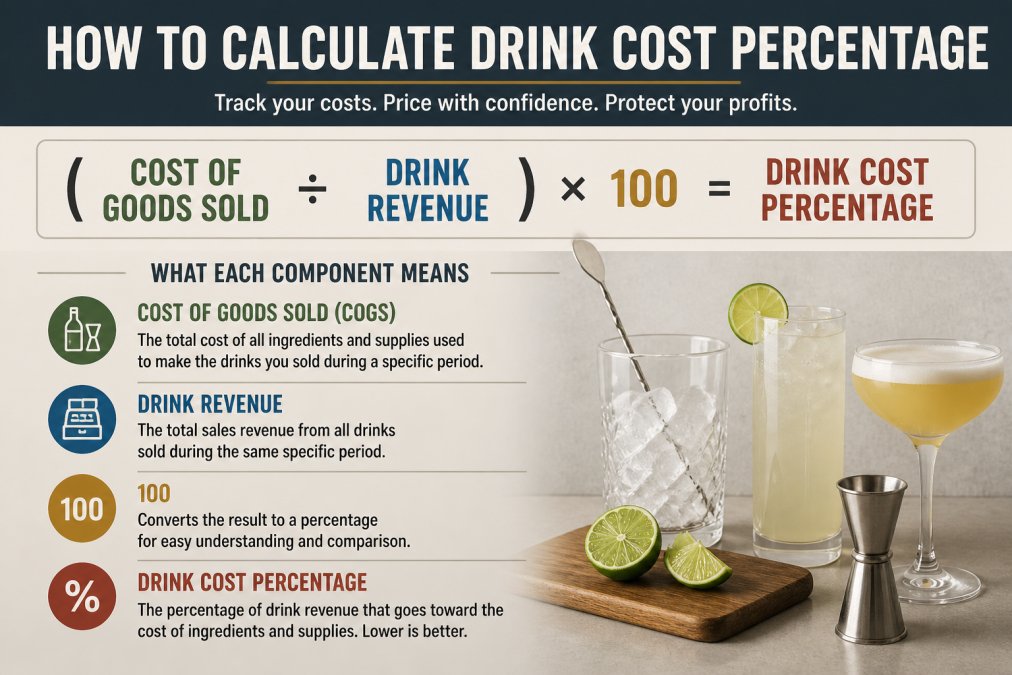
The formula is straightforward: (Cost of Goods Sold ÷ Drink Revenue) × 100 = Drink Cost Percentage.
Cost of Goods Sold (COGS) includes everything you paid for the drinks you sold during the period. If you bought 100 bottles of wine in January but only sold 60, the cost of those 60 bottles counts toward COGS. The remaining 40 stay on your balance sheet as stock.
Drink Revenue is the total money you earned from selling drinks during the same period. The percentage tells you how many pence of every pound you earn goes toward paying for the drinks themselves. A 30% drink cost percentage means you spend 30p to generate £1 in drink sales. The remaining 70p covers labour, overheads, and profit.
Let's say your gastropub in Birmingham had the following month:
Beginning stock value: £2,400 Purchases during the month: £3,100 Ending stock value: £2,200
Your COGS = Beginning stock + Purchases − Ending stock = £2,400 + £3,100 − £2,200 = £3,300
If your total drink revenue for the month was £11,000, your calculation is: (£3,300 ÷ £11,000) × 100 = 30%
You spent 30p on drinks for every pound of revenue. For most independent venues, this is healthy. The real power of this calculation is tracking it month to month. If your percentage was 28% last month and 30% this month, something changed. Did you purchase more premium wines? Did waste increase? This metric forces you to investigate.
Over-pouring is the silent killer of drink margins. A bartender who pours 50ml instead of 40ml on a spirit pour is giving away 25% more product for the same price. Without defined portion control systems, your actual pour cost drifts upward invisibly.
Standard pours in UK hospitality are typically 25ml, 40ml, or 50ml for spirits, depending on your venue positioning. Many gastropubs use 50ml as standard to justify premium pricing. High-volume nightclubs use 40ml to protect margins. The key is consistency. Once you define your standard, enforce it through training, measurement, and accountability.
Jiggers, pourers, and measured dispensing systems eliminate guesswork.
Wastage includes spills, broken bottles, and drinks that don't meet standard. Spoilage includes stock that expires, oxidises, or becomes unserviceable. Together, they're often invisible until you audit.
The solution is systematic stock rotation using FIFO (First In, First Out). Older stock moves forward; newer stock goes to the back. This prevents ageing and spoilage.
Stock variance is the difference between what your records say you should have and what you actually have. Some variance is normal (spillage, measurement error). But large variance signals theft, undocumented waste, or poor record-keeping.
The fix is regular stock audits (monthly minimum, weekly for high-risk venues). Count physical stock, compare it to your records, and investigate variance. If you're consistently 5-10 bottles short each month, you have a problem worth addressing.
Your drink cost percentage isn't static. Wholesale prices fluctuate based on global supply chains, harvest conditions, and currency movements. When your supplier's costs rise, they pass increases through to you. If you're locked into fixed menu prices, your margin compresses instantly.
Work with a supplier like Swallow Drinks who understands your business and can offer stability. A supplier with consistent six-day-a-week delivery and transparent pricing helps you forecast and plan.
Define your standard pours for every spirit, wine, and draught option. Write them down. Train every bartender to that standard. Use jiggers or measured pourers until the habit sticks.
For draught beer, standardise your glass sizes and pour technique. For wine, use consistent glassware. Track your portion control by calculating your theoretical COGS. If you sold 500 spirit pours at 40ml, your theoretical cost is 500 × 40ml × unit cost. Compare that to your actual COGS. The gap is your over-pouring.
Modern point-of-sale (POS) systems can track every drink sold, calculate real-time COGS, and flag variance. When your POS is integrated with your stock management, you get visibility you'd never have manually.
A bartender rings in a spirit pour, the system logs it. At the end of the shift, you know exactly how many spirit pours were sold and what they cost. You can compare that to your physical stock count. Discrepancies show up immediately.
When you can show Swallow Drinks your exact usage patterns, they can recommend products that fit your business better.
Monthly stock audits are non-negotiable. Count your physical stock, compare it to your records, and investigate variance. A 2-3% variance is normal. Anything above 5% signals a problem worth investigating.
The audit process: count everything. Every bottle, every keg, every case. Record the count. Compare to your system records. Calculate variance by category (spirits, beer, wine, soft drinks). Investigate large discrepancies.
Venues that audit monthly catch problems early. A bartender who's over-pouring gets feedback. A supplier delivery that's short gets resolved. A stock rotation problem gets fixed before it becomes spoilage.
Stock turnover measures how quickly you move through your stock. High turnover is good, it means you're selling stock before it ages or spoils. Calculate your stock turnover by dividing your COGS by your average stock value. If your COGS is £3,300 per month and your average stock value is £2,300, your turnover is 1.43 times per month.
For most venues, a turnover of 1.5-2.5 times per month is healthy. Anything below 1 suggests you're carrying too much stock. Anything above 3 suggests you might be running too lean and risking stockouts.
FIFO (First In, First Out) rotation ensures older stock moves before newer stock. When a delivery arrives, it goes to the back. Staff pull from the front. This prevents bottles sitting for months and becoming stale or oxidised. Make FIFO part of your closing checklist.
Your supplier relationship directly impacts your drink cost percentage. A supplier who delivers inconsistently forces you to over-stock to avoid running out. Over-stocking increases spoilage and ties up cash. A supplier who delivers on schedule lets you order just what you need.
Swallow Drinks, as a family-run independent wholesaler with over 40 years' experience, understands this. Consistent six-day-a-week delivery across the West Midlands means you're not stocking for uncertainty. You order for your actual needs, not buffer stock.
A good supplier helps you curate your selection. A purchasing manager at a boutique hotel group doesn't just want someone taking orders, they want a partner who understands their menu and guest expectations. Swallow Drinks offers that. They can recommend premium wines, craft beers, and niche local labels that fit your positioning. Transparent pricing lets you calculate your actual costs and plan accordingly.
Your menu design directly impacts your drink cost percentage. A menu heavy on high-margin drinks (spirits, soft drinks) will have a lower percentage than one heavy on wine and draught beer.
Consider placement and description. A wine described as "house wine, £18" has lower perceived value than one described as "2022 Côtes du Rhône, £18." Guests who perceive higher value are less price-sensitive and more likely to order premium options.
The data from your POS system tells you which drinks are profitable and which aren't. Use this data to engineer your menu toward profitability.
Your target drink cost percentage should reflect your venue type, positioning, and local market. Start by calculating your drink cost percentage for the last three months. Average them. That's your baseline. Now, identify your venue type peer group. Are you a gastropub, a nightclub, a hotel bar, or a restaurant?
Estimate their drink cost percentage based on their positioning. A gastropub with premium wine focus might target 35-38%. A high-volume nightclub might target 22-26%. A hotel bar might target 30-33%. Your target should sit in that range, adjusted for your specific circumstances.
Set up a simple spreadsheet or use your POS system to track your drink cost percentage monthly. Record the date, your COGS, your revenue, and your calculated percentage. When your percentage moves more than 2-3 percentage points month to month, investigate. Did you change your menu? Did prices rise? Did waste increase?
Many venues also track by category. Your spirits percentage, your beer percentage, your wine percentage, and your soft drinks percentage separately. This shows you which categories are drifting and need attention.
The venues that succeed at this aren't doing anything complicated. They're tracking monthly, comparing to their target, and acting when they see drift. That discipline compounds into real profitability.
Your drink cost percentage is the single metric that determines whether your drinks operation funds your business or drains it. Understanding how to calculate it, what factors influence it, and how to control it separates venues that thrive from those that survive.
The venues that master this build sustainable, profitable operations. They work with suppliers like Swallow Drinks who deliver consistently, offer transparent pricing, and help curate selections that fit their positioning. They implement portion control systems. They rotate stock properly. They audit monthly.
Start tracking your drink cost percentage this month. Calculate your baseline. Set your target based on your venue type and positioning. Then focus on the three levers that move the needle: portion control, waste reduction, and strategic menu engineering. Within 90 days, you'll see the shift in your margins.
For independent pubs, gastropubs, and hotel groups across the West Midlands, Swallow Drinks can be that partner. With over 40 years of experience, consistent six-day-a-week delivery, and a vast portfolio of premium wines, spirits, beers, and soft drinks, we help you source what you need without the complexity. Register for trade ordering at Swallow Drinks Trade Portal.
Most UK pubs target between 20-30% drink cost percentage, with 25% being a common benchmark. However, this varies by venue type: high-volume nightclubs may run 18-22%, while gastropubs with premium wines might operate at 28-32%. Your target depends on your drink mix, pricing strategy, and local market. Track your actual percentage monthly and adjust your menu pricing or supplier relationships if you drift significantly above your target.
Divide your total cost of drinks sold by your total drinks revenue, then multiply by 100. For example: if you spent £2,000 on stock during a period and generated £8,000 in drinks sales, your percentage is (£2,000 ÷ £8,000) × 100 = 25%. Use your opening stock value plus purchases minus closing stock to find your cost of goods sold (COGS). Many venues use POS systems to track this automatically, reducing manual calculation errors and revealing trends month-to-month.
Pour cost focuses on a single drink's profitability—the cost of the drink divided by its selling price. Drink cost percentage measures your entire drinks programme across all sales. A £1.50 pint of bitter with a 50p cost has a 33% pour cost, but your overall drink cost percentage reflects all drinks sold. Monitoring both matters: pour costs help you price individual items correctly, while drink cost percentage shows whether your entire drinks operation is profitable.
Start with portion control: use measured pourers to prevent over-pouring, which is the largest source of waste in most bars. Second, conduct monthly stock audits to catch theft and variance early. Third, review your menu: high-margin drinks like soft drinks and house spirits should feature prominently. Fourth, work with a reliable supplier who offers consistent pricing and on-time delivery—stock-outs force emergency purchases at premium rates. Finally, train staff on proper handling to reduce breakage and spillage.
Yes, significantly. Draft beer typically costs 15-20% due to bulk pricing, while premium spirits run 25-35%. Wine ranges from 20-40% depending on quality. Soft drinks and non-alcoholic options often sit at 10-15%, making them excellent margin-builders. High-volume venues with a beer-heavy mix naturally run lower percentages than wine bars or cocktail lounges. Review your drink mix quarterly: shifting towards higher-margin categories can improve your overall percentage without raising prices.
Most UK bars experience 2-5% wastage, though this varies by venue type and control standards. High-volume nightclubs may see 4-6% due to rapid service and breakage, while carefully managed gastropubs often keep it below 3%. Wastage includes spillage, breakage, over-pouring, and spoilage. If your wastage exceeds 5%, review your staff training, portion control systems, and stock rotation practices. Regular audits and accountability measures help keep wastage within acceptable limits.
Fast stock turnover keeps your stock fresh, reduces spoilage, and minimises capital tied up in slow-moving drinks. A bottle that sits on the shelf for months risks expiration or oxidation, becoming unsellable waste. Turnover also reduces theft risk and helps you respond quickly to market trends. Most healthy venues turn their drinks stock 4-6 times per year. Use FIFO (first in, first out) rotation to ensure older stock sells first, and work with suppliers who deliver frequently to maintain freshness without overstocking.
Members of:


AWRS Registration Number: XJAW00000100730