Aug 15, 2026
Last Updated: August 15, 2026
The difference between a struggling bar and a thriving one often comes down to one metric: how much each customer spends during their visit. At Swallow Drinks, we work with hundreds of independent bars across the region and have seen firsthand how small shifts in approach transform venue profitability.
A customer spending £8 instead of £6 per visit might seem marginal, but across 100 customers per night, that's an extra £200 in revenue, roughly £73,000 annually. That money flows directly to your bottom line because operating costs remain the same.
Most customers come wanting to enjoy themselves. They're not resistant to spending more; they simply need guidance. They might not know about your premium spirit selection, realise your cocktails come in different sizes, or have considered adding food to their evening. Your job is to make those options visible and appealing.
Understanding your current position is essential before you can improve it. Your average transaction value is the foundation for measuring progress.
Average Transaction Value = Total Revenue ÷ Number of Transactions
If your bar generates £5,000 in revenue across 625 transactions in a week, your average transaction value is £8 per customer. This baseline is crucial for tracking progress.
To calculate accurately, use your point of sale data. Most modern tills generate transaction reports showing total revenue and transaction count. Once you have your baseline, set realistic targets. A 10% improvement from £8 to £8.80 per transaction adds £26,000 annually without requiring new customers.
Many bar operators focus exclusively on footfall. Increasing average spend per customer from existing traffic is often easier to control and more profitable to execute.
Upselling isn't manipulation. It's presenting customers with better or premium options that genuinely enhance their experience. The best upselling happens when staff have genuine knowledge and confidence.
The moment a customer orders is your highest-value opportunity. Instead of asking "Would you like anything else?", staff should make specific recommendations. "That lager pairs beautifully with our charcuterie board" or "We've just got in a fantastic single malt if you fancy exploring something different" gives customers a concrete option.
Timing matters enormously. Suggest additions before the customer has paid. Staff confidence is non-negotiable, if your team hesitates, customers pick up on it immediately. Confidence comes from product knowledge; your team needs to understand what they're selling, why it's worth the price, and who it appeals to.
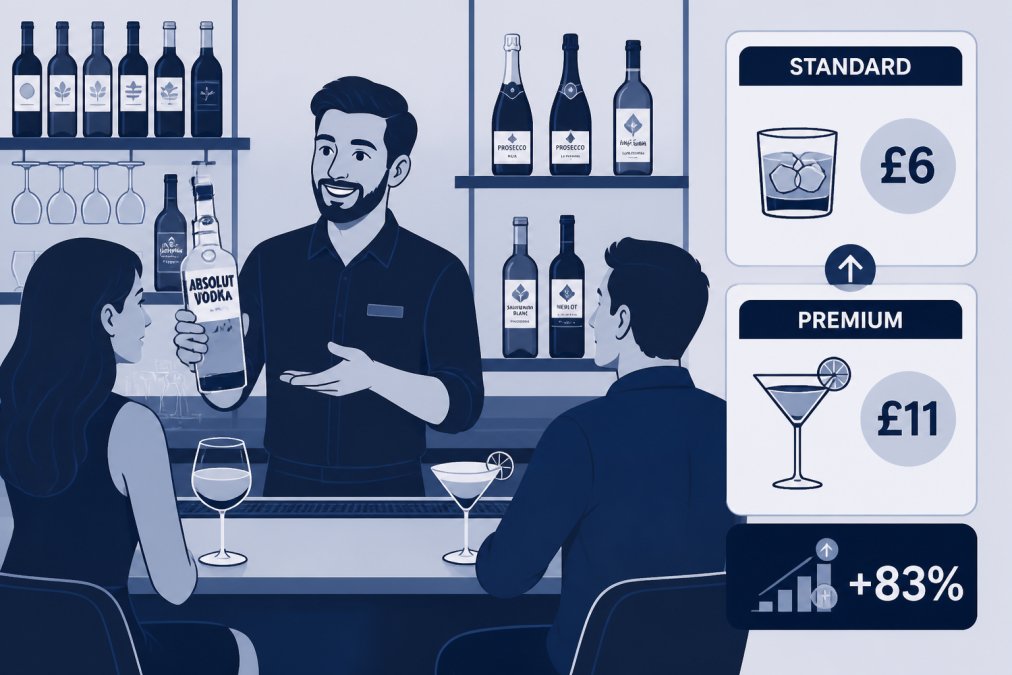
Positioning premium options prominently is a core upselling technique. Many customers default to standard versions simply because they're familiar. A standard spirit and mixer might cost £5-£7. A signature cocktail using premium spirits and fresh ingredients can command £9-£14. The margin difference is substantial, and customers perceive cocktails as a treat.
Train staff to verbally highlight 2-3 premium cocktails each shift. Rotate them to create exclusivity and urgency. Premium spirits deserve particular attention; a brief tasting note can prompt curiosity. Some venues use spirit flights or small tasting measures to let customers try premium options before committing to a full serve.
Menu engineering strategically designs and positions offerings to influence purchasing decisions and maximise profitability. Done well, it's one of the most powerful levers for increasing average spend per customer.
The physical position of items on your menu dramatically affects what customers order. Items in the top third are seen first and ordered more frequently. Premium items placed strategically draw attention without seeming out of reach.
Grouping is equally important. If all cocktails are listed together, customers compare directly and often choose the cheapest. Separating signature cocktails from classics, with more detailed descriptions, commands higher prices. "Elderflower and gin with fresh tonic" is functional. "Our signature garden cocktail, local elderflower, premium gin, premium tonic, fresh mint" tells a story and justifies a higher price.
Pricing psychology matters too. A cocktail priced at £12.50 feels more premium than £12. For premium spirits, showing the measure (25ml, 50ml) alongside the price helps customers understand what they're getting.
One of the most effective upselling techniques is introducing food offerings. Food increases dwell time; customers stay longer, which typically means more drinks. It also creates reasons for customers to visit at different times of day.
Food doesn't need to be elaborate. Charcuterie boards, sharing platters, and simple hot food work exceptionally well. Customers who order food typically spend 20-30% more per visit because they're staying longer and ordering additional drinks.
Swallow Drinks supplies quality snacks and accompaniments that work perfectly for this strategy. Our Pipers crisps range, including Anglesey Sea Salt and Cheese & Onion varieties, are affordable, profitable, and appeal across all demographics. Introducing these alongside premium drinks creates a natural upsell opportunity.
Your staff are the frontline of any upselling strategy. No menu engineering or pricing strategy matters if your team doesn't execute it with confidence and authenticity.
Staff confidence comes directly from product knowledge. When your team understands the difference between a blended whisky and a single malt, when they can describe flavour profiles of your premium gin, when they know which spirit pairs with which mixer, that knowledge translates into confidence.
Create tasting sessions for your team. Let them experience products firsthand. A staff member who's tasted your premium gin can speak about it authentically. Schedule these during quieter periods so staff can focus without time pressure.
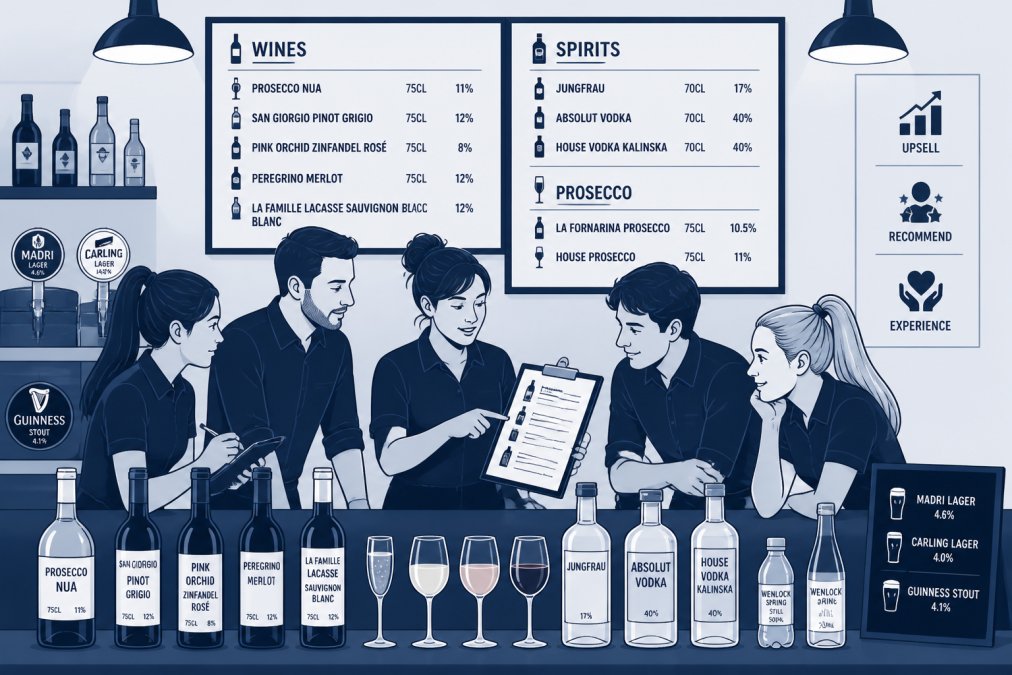
Financial incentives work. When staff earn commission or bonuses for increasing average spend per customer, they're motivated to apply what they've learned. A common structure is small commission on premium spirit sales, perhaps 5-10p per premium serve. Over a shift, a bartender might earn an extra £5-10 through commission.
Team-based bonuses work well too. If the entire bar hits its average spend target for the week, everyone gets a bonus. This creates peer accountability and prevents aggressive individual selling.
Recognition matters as much as money. Publicly acknowledging the staff member who achieved the highest average spend that week creates motivation and friendly competition. Many venues display weekly leaderboards or mention achievements in team meetings.
Customer loyalty schemes create repeat visits and increase lifetime value. They're also a powerful tool for increasing average spend per customer because they can be structured to reward higher-value purchases.
A simple scheme might offer a free drink after 10 purchases. A more sophisticated one offers accelerated rewards for premium purchases, perhaps two loyalty points for a standard drink but four points for a premium cocktail. This incentivises customers to spend more per visit.
Digital loyalty programmes work better than physical punch cards. Apps and SMS-based systems allow you to track customer preferences, send targeted offers, and measure effectiveness. You can offer birthday discounts, early access to new cocktails, or special pricing on premium spirits to regular customers.
Implement your scheme gradually. Start simple with a basic app-based system. Track which customers participate and what they order. Use this data to refine your approach. Some venues find that offering double points on certain days drives traffic during slower periods while increasing average spend per customer.
Pricing is perhaps the most sensitive lever for increasing average spend per customer. Raise prices too aggressively and you'll lose customers. Price too conservatively and you're leaving money on the table.
Start by benchmarking your current pricing against similar venues in your area. Your positioning should match your offering. A casual neighbourhood bar can't charge premium cocktail prices.
Incremental price increases are far less noticeable than large ones. A 5-10% increase spread across your menu and implemented gradually is unlikely to trigger customer resistance. A 20% increase all at once will drive customers away.
Premium product pricing deserves special attention. Customers expect premium spirits and cocktails to cost more. A standard spirit and mixer might be £6, but a premium cocktail using rare spirits and fresh ingredients should be £12-14. The customer understands the difference and accepts the premium.
Psychological pricing strategies work. Prices ending in .50 feel more considered than round numbers. Bundled pricing, "two cocktails for £20", feels like better value than listing individual prices. Removing the pound sign from menus reduces the psychological impact of price and increases purchasing.
Monitor the impact of price changes carefully. Track your average spend per customer weekly. If a price increase causes a significant drop, you've gone too far. If it holds steady or increases, you've found the right level.
You can't improve what you don't measure. Tracking average spend per customer validates your strategies and identifies what's working.
Set up a simple tracking system. Your point of sale system should provide weekly reports showing total revenue and transaction count. Calculate your average spend per customer every week. Plot it on a spreadsheet or chart. You're looking for trends, not daily fluctuations. A consistent upward trend over 4-8 weeks indicates your strategies are working.
Break down your data by category. What's the average spend per customer on cocktails versus spirits versus beer? Which staff member consistently achieves the highest average spend? Which time of day sees the highest average spend? This granular data reveals what's driving results.
Implement changes one at a time when possible. If you introduce a new menu, launch a loyalty scheme, and adjust pricing all in the same week, you won't know which change drove results. Stagger implementation so you can measure the impact of each initiative.
Connect your measurement to staff performance. Share your average spend per customer metric with your team. Help them understand why it matters and how their actions affect it.
| Metric | Calculation | Frequency | Action |
|---|---|---|---|
| Average Spend Per Customer | Total Revenue ÷ Transactions | Weekly | Identify trends and set targets |
| Premium Cocktail Sales | Premium cocktails sold ÷ Total cocktails | Weekly | Assess menu positioning effectiveness |
| Food Revenue | Food sales total | Weekly | Evaluate food upselling success |
| Loyalty Scheme Participation | Active loyalty members ÷ Total customers | Monthly | Refine scheme structure |
| Staff Performance | Avg spend by staff member | Weekly | Recognise high performers |
Increasing average spend per customer is fundamentally about understanding your customers and presenting them with options that genuinely enhance their experience. The strategies covered here, from menu engineering to staff training to loyalty schemes, work because they're built on genuine value, not manipulation. Your customers want to enjoy themselves. Your job is to make premium options visible, your staff confident, and your venue worth returning to.
With consistent execution and careful measurement, you'll see your average spend per customer rise steadily. For support in building a premium drinks portfolio that supports these strategies, Swallow Drinks has spent 40 years helping independent venues across the region source the quality stock that drives higher-value orders. Our team understands the on-trade sector intimately and can help you curate offerings that work for your specific venue. Explore our full range and consider joining our trade ordering platform to simplify your stock management and access dedicated support for your business.
Divide total revenue by the number of customers served over a set period. For example, if your bar generates £5,000 in revenue from 250 customers, your average spend per customer is £20. Track this weekly or monthly to spot trends. Use point-of-sale data to automate this calculation and identify which shifts, staff members, or menu items drive higher transaction values.
Start with suggestive selling: recommend premium spirits or cocktails when customers order. Use descriptive language (tasting notes, origin, craftsmanship) rather than just the name. Bundle offerings, suggest snacks with drinks or create prix fixe packages. Train staff to recognise customer intent: someone ordering a standard lager might appreciate an upgrade to a craft option. Incentivise staff with commission on premium sales to maintain consistency.
Position high-profit items prominently on menus, top, centre, or in boxes. Use category names strategically: 'Signature Cocktails' commands higher prices than 'House Drinks'. Balance menu breadth: too many options paralyse customers, too few limit upsell opportunities. Pair drinks with food offerings to extend dwell time and increase average transaction value. Seasonal specials create urgency and encourage trial of premium products.
Well-trained staff build customer confidence in recommendations, directly increasing ticket size. Training should cover product knowledge, upselling scripts, and reading customer cues. Implement incentive programmes tied to average spend metrics, staff motivated by commission consistently achieve 15-20% higher transaction values. Regular briefings on new stock, promotions, and menu changes keep staff engaged and knowledgeable. Swallow Drinks can support this through consultation on curated stock selection and menu planning.
Members of:


AWRS Registration Number: XJAW00000100730