Aug 08, 2026
Last Updated: August 8, 2026
Overstocking erodes bar margins rapidly. You tie up cash in stock that moves slowly, expires, or sits forgotten behind the bar. Beyond locked capital, you face carrying costs, space, temperature control, staff time managing excess stock, and wastage when bottles expire or break. Bars that overstock typically lose 15-20% of stock value through breakage, spillage, or expiration before it reaches a customer's glass.
The solution lies in understanding actual demand and matching stock levels precisely. At Swallow Drinks, we've spent over 40 years working with independent bars across Birmingham and the West Midlands. The bars that thrive aren't those with the biggest stockrooms, they're the ones with the tightest control over what they order and when. They know their par levels, track what's moving, and adjust ruthlessly.
Overstocking ties up capital that could improve stock quality, marketing, or staff training. It masks inefficiency and creates waste. Understanding the mechanics makes it entirely preventable.
Par levels are your foundation. A par level is the minimum quantity needed on hand to cover demand between deliveries without running out. Get this right, and everything else becomes manageable.
Calculating par levels requires three pieces of information: your sales velocity (units sold daily), your lead time (days between ordering and delivery), and a safety buffer for unexpected demand spikes.
The formula is: (Daily Usage × Lead Time in Days) + Safety Stock = Par Level.
For example: if you sell 8 bottles of a house spirit daily, your supplier delivers every 3 days, and you want a 2-day safety buffer, that's (8 × 3) + (8 × 2) = 40 bottles. Your par level is 40. When you drop to 40, you reorder.
Most bars set par levels on gut feeling rather than data, resulting in massive unjustified buffers. Track usage for at least two weeks across core products. Note daily quantities sold. Identify your delivery schedule. Calculate honestly based on genuine variability, not paranoia.
Once calculated, write par levels down, share them with your team, and make them visible in your stockroom. They become your control mechanism.
Real-time tracking transforms stock control from guesswork into precision. You cannot manage what you don't measure, and you cannot prevent overstocking if you count stock only monthly.
Real-time stock tracking means knowing, at any moment, how much of each product you have on hand. For independent bars, combine manual counts at key points with digital recording. Count your critical stock items (top 20-30 products by revenue) at the start of each shift. Record what you have and what you sold. This takes 10 minutes if organised.
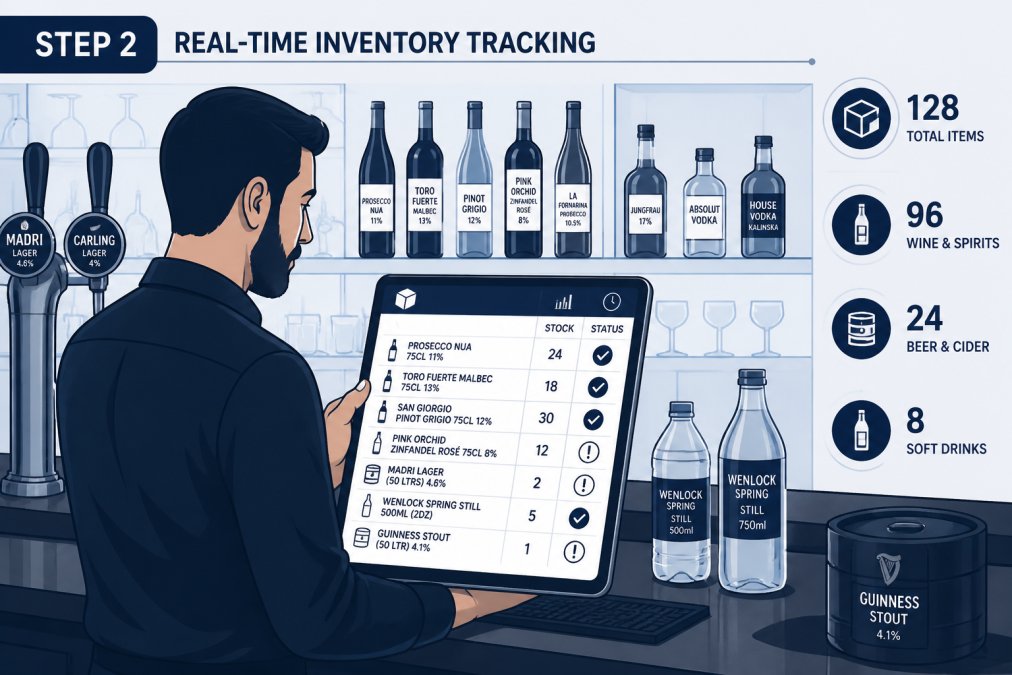
Use a simple spreadsheet or dedicated stock app. Swallow Drinks customers often use systems that sync with their POS, but even a paper ledger works if kept current. Consistency matters more than the system itself.
Know when you're approaching par. When stock hits the reorder point, place an order based on data, not guesswork. Real-time tracking reveals patterns: products moving faster on weekends, seasonal shifts, and dead stock before expiration. This visibility separates bars that prevent overstocking from those discovering overstocking only during counts.
Your point-of-sale system holds your most accurate demand data. Every transaction shows what customers ordered, when, and how much they paid. Most bars ignore this beyond daily takings, a missed opportunity.
Pull POS data for the last 12 weeks. Group by product. Calculate average daily sales for each item. Look for patterns: do certain products spike on Friday nights? Do they drop in summer? Does a new menu item cannibalize older ones?
If you know a spirit sells 6 units on an average Tuesday but 14 on Friday, adjust your par levels accordingly. Order more before weekends and less before quiet Tuesdays. If gin sales spike 40% in summer, build stock gradually in May and June rather than panic-ordering in July.
Swallow Drinks can help you access product-level sales data and build forecasts aligned with your delivery schedule, matching stock to actual demand rather than theoretical or worst-case scenarios.
A bar stocktake is your audit mechanism, revealing whether tracking is accurate, whether your team follows procedures, and whether you have hidden waste or shrinkage.
Schedule your stocktake during a quiet period, ideally a Monday morning. You need focus and accuracy, not rushing between service.
Divide stock into sections: spirits, wines, beers, soft drinks, mixers. Work through each systematically. Count every bottle. Record the count. Don't estimate.
For each product, compare your physical count to what your system says you should have. The difference is your variance. Small variances (under 2%) are normal and reflect spillage or minor recording errors. Large variances (5%+) indicate a problem: inaccurate tracking, team non-compliance, or shrinkage needing investigation.
Use your stocktake to recalibrate par levels. If actual stock significantly exceeds par levels, you're overstocking, adjust downward. If you're consistently running low, adjust upward. Many bars conduct monthly stocktakes; some do quarterly. Frequency depends on your size and complexity.
Waste and shrinkage are hidden costs of overstocking. Excess stock inevitably disappears: bottles break, drinks are poured incorrectly and discarded, products expire, or staff give away free drinks without recording them.
Reducing bar waste and shrinkage starts with awareness. Your stocktake should quantify shrinkage. If your variance is 8%, you're losing 8% of stock value to waste and unrecorded movement.
Primary causes of shrinkage include:
Spillage and Breakage. Some loss is unavoidable, but excessive loss indicates poor handling or inadequate training. Ensure your team handles stock carefully and reports breakage immediately.
Pouring Errors. Staff pour too much, realise the mistake, and discard the drink without recording it. Train your team on correct pour sizes and create a culture where mistakes are reported, not hidden.
Expired Stock. Products sit too long and expire. This links directly to overstocking. Tighter stock control prevents this entirely.
Unrecorded Giveaways. Staff offer free drinks without recording them. Every drink leaving the bar should be recorded in the POS system, whether sold or given away.
Theft. Regular stocktakes catch this. Consistent unexplained shrinkage indicates a theft problem requiring direct addressing.
The solution is layered: tighter stock control prevents overstocking and expired products; training and clear procedures reduce errors and unrecorded giveaways; regular stocktakes catch problems early; and accountability makes staff aware that discrepancies are noticed.
Once you understand par levels and demand patterns, automate reordering. This removes guesswork and ensures consistent ordering based on data.
An automated reorder point is a trigger: when stock drops to a specific level, you automatically place an order. This prevents both stockouts and overstocking.
You need to know your lead time, days between placing an order and its arrival. If your supplier delivers every 3 days, your lead time is 3 days. This determines when you need to reorder.
Your reorder point should trigger ordering before you run out, accounting for lead time and usage rate. If you use 5 units daily and your lead time is 3 days, you need at least 15 units on hand when you order (5 × 3). Add your safety stock on top.
Many modern POS systems and stock management tools allow automated alerts. When stock hits your reorder point, you get a notification. Some systems integrate with your supplier to place orders automatically. Swallow Drinks works with bars using various systems and can help align your reorder points with our delivery schedule.
Automation ensures consistency, you're not relying on someone remembering to check stock. However, review reorder points quarterly. If sales patterns change, adjust accordingly. The system works only if kept current.
Perishable stock, wines, beers, and certain spirits that degrade over time, requires special attention. Unlike shelf-stable products, perishables have a finite lifespan. Overstocking perishables guarantees loss.
Wines and craft beers deteriorate if stored incorrectly or kept too long. A wine stored in a warm stockroom loses quality quickly. A beer sitting for six months tastes flat. These products become unsellable before expiration.
Use FIFO (First-In-First-Out) rotation religiously. The oldest stock goes out first. Train your team to check dates and rotate stock every delivery. This prevents old stock being forgotten at the back of a shelf.
For wines and premium beers, consider ordering smaller quantities more frequently. If you normally order weekly, try twice weekly for perishables. You'll have fresher stock, less waste, and lower overstocking risk.
Dead stock, products not selling, is another challenge. These items seemed good when ordered but haven't found an audience. They sit on your shelf, taking up space and capital.
Identify dead stock through POS data. If a product hasn't sold in 30 days, it's dead. Rather than waiting for expiration, liquidate it. Sell at cost or a small discount to move it. Offer it as a special to clear it. Free up capital and space for stock that actually sells.
Preventing overstocking in bars comes down to understanding demand, setting precise par levels, and maintaining discipline around stock control. The bars that thrive treat stock management as seriously as recipes and customer service. They know their numbers, track religiously, and adjust based on data.
Swallow Drinks has worked with independent bars across Birmingham and the West Midlands for over 40 years, helping operators build efficient stock systems matching delivery schedules and demand patterns. If you're ready to tighten stock control and prevent waste from overstocking, our team can help establish systems and discipline that work. Access our trade ordering platform for real-time stock management to simplify your reorders and align purchasing with actual demand. We're here to support bars that take their business seriously.
Overstocking typically stems from inaccurate demand forecasting, lack of real-time tracking, and failure to adjust orders based on sales velocity. Many bars order based on supplier discounts or habit rather than actual consumption patterns. Without proper par levels and stock reconciliation, stock accumulates faster than it sells, tying up cash and increasing waste, especially with perishable items like draught beer and premium spirits that deteriorate or go out of fashion.
Most UK bars should conduct a full stocktake monthly, with spot-checks weekly on high-value items like premium spirits and draught lines. High-volume venues may benefit from fortnightly full audits. Monthly stocktakes reveal shrinkage patterns, identify dead stock early, and provide accurate data for demand forecasting. Regular audits also catch discrepancies between POS records and physical stock, which is essential for calculating accurate par levels and reorder points.
Extract sales velocity data from your POS system to identify which products move quickly and which sit idle. Calculate the average units sold per day for each product, then multiply by your supplier's lead time plus a safety buffer to set your reorder point. This ensures you order only what you'll sell before the next delivery. Track seasonal trends—cocktail ingredients and lighter drinks sell faster in summer, while spirits dominate winter. Adjust par levels quarterly based on these patterns to avoid holding dead stock.
Overstocking directly reduces cash flow by locking money into stock that sits on shelves rather than generating revenue. Perishable goods deteriorate, forcing write-offs. Carrying costs—storage, insurance, and spoilage—accumulate. Dead stock ties up capital that could fund staffing, maintenance, or menu innovation. For independent bars, this cash drain is critical; a single month of overstocking can delay supplier payments or equipment repairs. Proper par levels and demand forecasting free up thousands of pounds annually that can be reinvested into your business.
Members of:


AWRS Registration Number: XJAW00000100730