Nov 08, 2026
Last Updated: November 6, 2026
Quick Summary
Local spirits give a gastropub a drinks menu guests cannot find elsewhere, invite conversation between staff and guests, and make provenance easy to show. Sourcing them also keeps money in the region and supports a community-focused story. Shorter supply chains can help keep the back bar stocked through busy trade.
Local spirits give a gastropub a drinks menu that guests cannot find anywhere else. At Swallow Drinks, we have supplied the on-trade for over 40 years. Venues that list a few well-chosen regional spirits can stand out from the chains. The benefits of sourcing local spirits for gastropubs go beyond the bottle. They shape how your menu reads, how your staff talk about drinks, and how guests remember your bar.
Local spirits also give your team something to talk about. A gin distilled a few miles away, or a rum made by a small producer, invites a conversation that a standard brand cannot. Your bar staff can explain where the spirit was made and why it suits a particular serve. That kind of knowledge builds confidence on the bar and gives guests a reason to order something new.
Watch out: a local spirit that appears only once in your menu is easy to forget. Rotate a small selection through the year, and name the producer clearly on the menu so guests know what they are ordering.
Provenance matters to many drinkers. Guests increasingly ask where a spirit comes from and how it was made. When your menu names the producer and the region, you answer that question before it is asked. Clear provenance is a simple way to build trust with a customer who wants to know what they are paying for.
Trust tends to turn into loyalty when guests find something they cannot get at the supermarket. A regular who discovers a local gin on your back bar may return specifically for it. Over time, a small, well-curated local range can become part of what people associate with your pub.
Transparency also helps your team. When staff know the story behind each spirit, they can recommend it with conviction rather than reading from a list. That honest recommendation is often what turns a curious guest into a repeat customer.
Buying local spirits keeps money in the region. When you source from a producer nearby, your purchase supports the people who make the product, the staff who bottle and ship it, and the suppliers they use in turn. Many gastropub owners value that connection, because it links the pub to the community it serves.
Community support also works as a marketing story. Guests who know that your drinks come from local makers often feel more connected to your venue. You can share that story on your menu, your website and your social channels, giving customers a reason to support your business in return.
Some owners find that local partnerships open other doors. Producers may run tastings, share recipes or join events at the pub. These relationships can add value beyond the spirit in the glass.
A shorter supply chain can mean fewer delays. When a producer is close to your venue, deliveries can be easier to plan around. For a busy gastropub, that predictability helps you keep the back bar stocked through a heavy weekend.
Consistency is just as important as speed. A supplier that understands your needs can help you keep a core range in stock while rotating in new releases. Ask any potential supplier how they manage stock levels, how often they deliver and what happens when a line sells out. Clear answers to these questions make it far easier to plan your menu.
Most local-sourcing articles stop at "find a supplier nearby". For spirits, the useful work starts when you assess whether a distiller or wholesaler can actually support a gastropub back bar week after week. A practical framework has four parts: range fit, reliability, commercial terms and support.
Range fit. Start by mapping the spirit styles your menu needs, gin, vodka, rum, whisky, liqueurs and any aperitif serves, against what each supplier can offer. A distiller with one flagship gin may be excellent for a signature serve but cannot anchor a full local range.
Reliability. A shorter supply chain only helps if deliveries actually arrive. Ask how often the supplier delivers to your area, what the minimum order is, how they handle out-of-stock lines and what notice they need for a new listing.
Commercial terms. Compare the delivered price per bottle, not the headline trade price. Ask about broken-bottle credits, returns on slow-moving lines and whether promotional support is available for staff training or menu launches. Clear terms matter more than a few pence off a bottle, because a line that ties up cash and space without selling costs more than it saves.
Support. The best supplier for a gastropub is one that helps you sell, not just one that takes orders. Ask whether they offer staff tastings, serve suggestions, cocktail recipes or menu copy. A supplier that knows your busiest nights and your food menu is far more useful than one that simply processes invoices.
Use this checklist when you compare options:
Watch out: a supplier who cannot confirm provenance in writing leaves you exposed if a guest or staff member questions a menu claim. Keep the paperwork for every local line you list.
At Swallow Drinks, we have supplied the on-trade for over 40 years, and our trade team can help you match local labels to your menu and your busiest nights. You can register for a trade account to see the wholesale range and plan stock around your trade.
The table below sums up the four checks to run when comparing local spirit suppliers.
| Check | What to ask | Why it matters |
|---|---|---|
| Range fit | Does the supplier stock a balanced range of local labels? | Avoids relying on one or two bottles |
| Provenance | Can they confirm producer location and method in writing? | Keeps menu claims accurate |
| Reliability | How often do they deliver, and what is the minimum order? | Keeps the back bar stocked |
| Commercial terms | What is the delivered price, including charges? | Shows the true cost per bottle |
| Support | Do they offer staff training, tastings or serve suggestions? | Helps you sell, not just order |
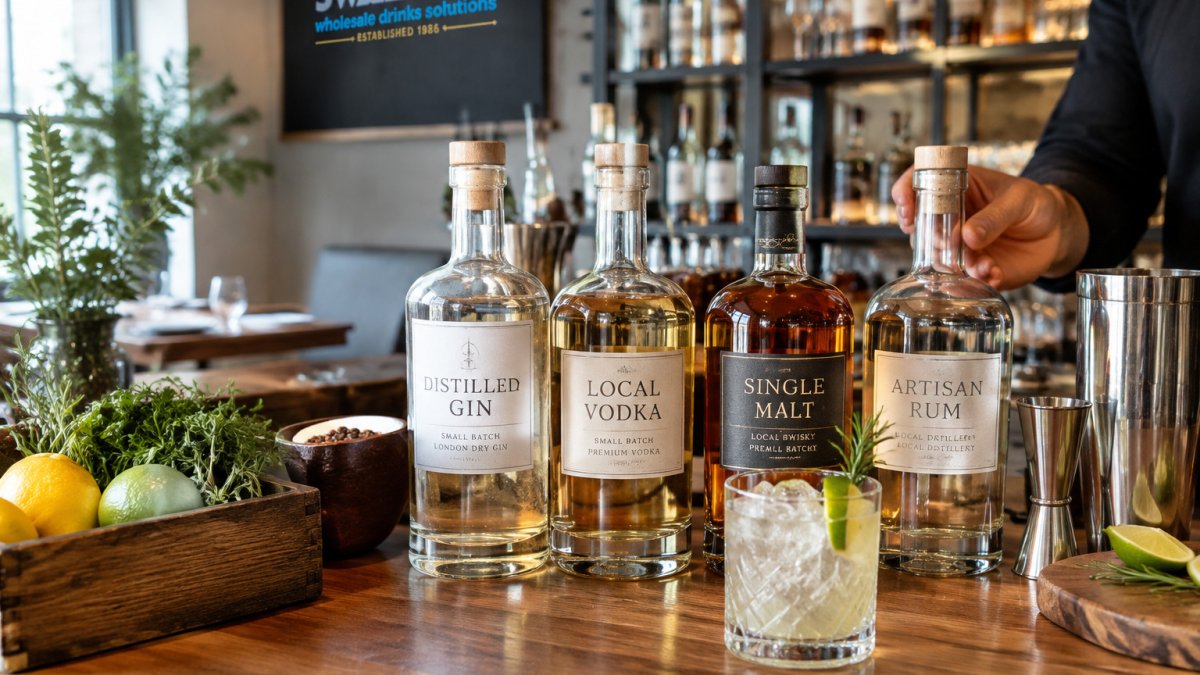
Gin is often the easiest starting point for local sourcing, but a gastropub gets more from it when the gin is tied to a specific serve, a food pairing and a clear price position on the menu.
Signature serves. Build one house serve around each local gin and name it on the menu. A London dry style with citrus and juniper suits a crisp gin and tonic with a seasonal garnish, while a softer, floral gin works in a longer drink with elderflower or a light tonic.
Tasting flights. Three 25ml measures of local gins, served with tonic on the side, give guests a reason to try something new and lift the average spend per head.
Food pairings. Local spirits pair well with gastropub dishes when the botanicals echo the food. A juniper-forward gin suits cured fish or a salty snack, a citrus-led gin works with fried dishes, and a sweeter, floral gin can sit alongside a dessert.
Pour cost and menu pricing. Local spirits often cost more per bottle than large-volume brands, so check the pour cost before you set the menu price. A common pattern is to price a local gin serve at a modest premium to a standard pour, then use the story and the garnish to justify it.
Ready-to-drink options. For busy nights, a canned ready-to-drink option keeps service quick without losing the local angle. You can view the canned gin and tonic options to see the full pack details. You can browse our ready-to-drink and premixed range and our canned ready-to-drink options to plan a menu that balances speed with character.
Watch out: a local gin that appears only once on the menu is easy to forget. Rotate a small selection through the year, and name the producer clearly so guests know what they are ordering.
At Swallow Drinks, we have supplied the on-trade for over 40 years, and our trade team can help you build a local gin range that fits your menu and your margins. You can register for a trade account to start planning your back bar.
Local spirits sell best when guests understand what they are tasting. Put the producer name and a short description on your menu. Ask staff to recommend one local spirit each shift, and give them a sentence or two to share. Small, specific prompts like these help a new drink move off the shelf.

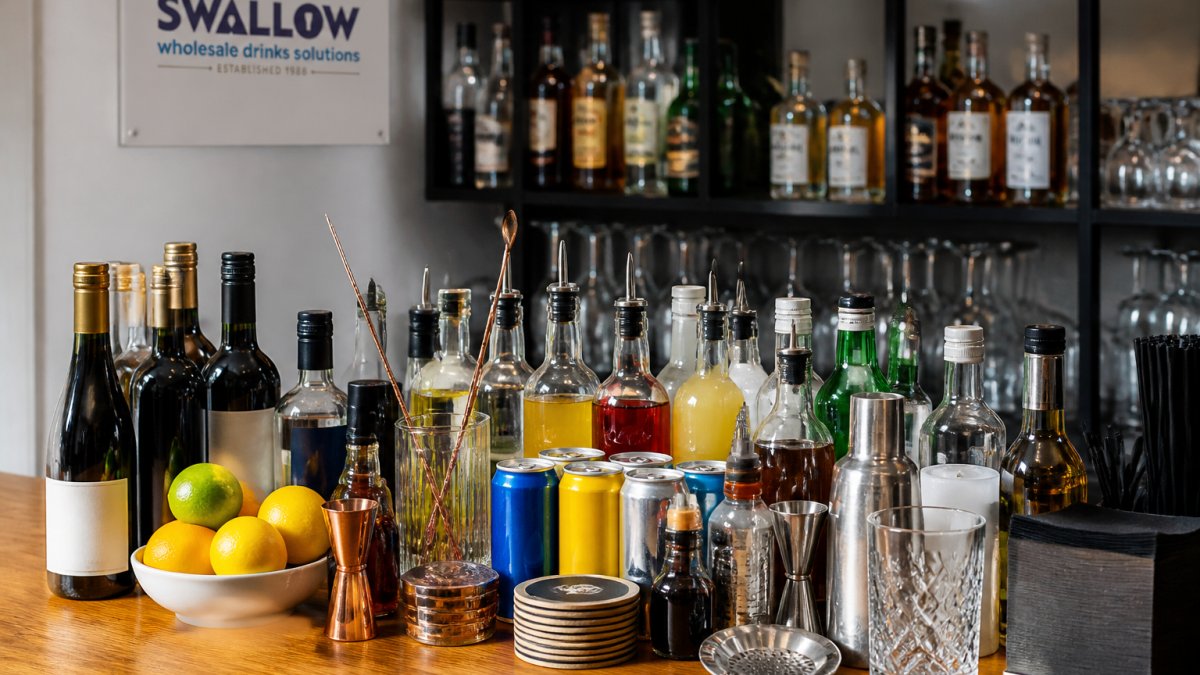
Visuals can help too. A well-lit bar scene, a clear shelf display or a chalkboard feature can draw attention to your local range. Keep the message simple and honest, and avoid overstating claims about a product you have not tasted yourself.
Promotions work best when they feel relaxed and easy to join. A local spirit night, a tasting flight or a seasonal serve can give guests a reason to try something new without feeling pushed.
If you are ready to build a local spirits range, the first step is to set up a trade account. Registering for trade ordering gives your venue access to our wholesale range, so you can plan stock around your menu and your trade. You can register for a trade account to start ordering. Our non-alcoholic drinks also help you cover every guest, including those who prefer a lighter option.
Local spirits give your gastropub a clear point of difference. At Swallow Drinks, we help venues across the West Midlands find the right labels for their menus. Get in touch through your trade account and start building a drinks list your guests will remember.
Local spirits give a gastropub a distinctive drinks menu, a clear provenance story and a reason for guests to return. They also help the business build relationships with nearby producers and keep money circulating in the local area. Customers who value local sourcing often respond well to a menu that explains where each drink comes from, and staff gain a story they can share at the bar. Swallow can help you find suitable labels for your menu through our trade ordering service.
Start by listing the spirit categories your menu needs, such as gin, vodka, rum or whisky, then look for producers within a practical distance of your site. Ask each supplier about production capacity, consistency of supply, delivery frequency and minimum order quantities before committing. A wholesaler with a broad portfolio can help you compare options and manage deliveries alongside your other drinks stock.
Yes. A spirit with a clear origin story gives your bar team something specific to talk about, and it gives guests a reason to choose your venue over a chain. Local gin and other regional spirits also suit seasonal cocktail menus and food pairings, which lets you change the drinks list without rebuilding your whole range.
Add the producer name, town and a one-line description next to each local spirit on the menu. Train staff to explain the product in a sentence or two, and use tasting notes on cocktail cards. Printed or chalkboard menus, social posts and table tent cards all work well for telling the story behind each drink.
Members of:


AWRS Registration Number: XJAW00000100730