Aug 16, 2026
Last Updated: August 16, 2026
Calculating cocktail profit margins is essential for any bar or hospitality venue looking to understand where money actually goes. Many venue managers operate blind without proper tracking of ingredient costs and pour sizes. The relationship between pour cost and gross profit margin determines whether your cocktail programme drives revenue or erodes it.
Pour cost is the percentage of a drink's selling price that goes directly toward the spirits, mixers, garnishes, and ice used to make it. If a cocktail sells for £12 and costs £3 in ingredients, the pour cost is 25%. Most bars operate with pour costs between 20-30%, though this varies by venue type, location, and menu positioning.
Your cocktail profit margins depend on three interconnected variables: ingredient cost per serving, standardised pour sizes, and actual selling price. Get one wrong and the entire calculation collapses. At Swallow Drinks, we've worked with independent venues across the region for over 40 years, and the venues that thrive are those that track these numbers obsessively.
Gross profit is the revenue from a cocktail sale minus the cost of goods sold.
Gross Profit = Selling Price − Ingredient Cost per Serving
Calculate your gross profit margin as a percentage:
Gross Profit Margin (%) = (Gross Profit ÷ Selling Price) × 100
Consider a vodka and tonic using House Vodka Kalinska at £12.41 per 70cl bottle. A standard 50ml pour costs approximately £0.89 in spirit alone. Add tonic (£0.15), ice (£0.05), and a lime wedge (£0.08), and your total ingredient cost is £1.17. If you sell this drink for £6.50, your gross profit is £5.33, giving you an 82% gross profit margin.
That 82% looks excellent until you account for operating expenses, bar staff wages, rent, utilities, and stock shrinkage. Your net profit is far lower. Gross profit margins of 75-85% on cocktails are typical for well-run bars, but net profit after all expenses usually sits between 10-20%.
The formula works identically for any cocktail. The discipline lies in tracking actual ingredient costs and updating them when supplier prices change.
Calculating the ingredient cost per serving requires you to know the total cost of each ingredient, the volume per serving, and the waste factor.
Start with your spirits. If you buy a 70cl bottle of Bombay Sapphire Gin at £21.70, that bottle contains approximately 14 standard 50ml pours. Your cost per pour is £21.70 ÷ 14 = £1.55 per 50ml serve.
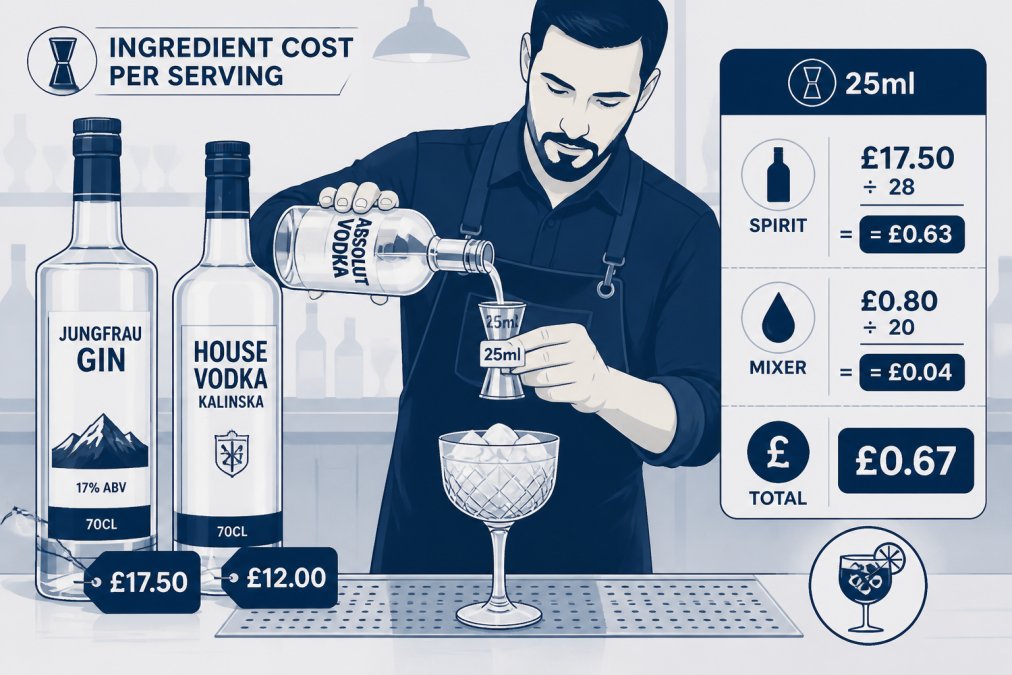
For mixers, calculate based on actual volume used. A bottle of tonic water typically contains 200ml. If you use 150ml per drink and a 200ml bottle costs £0.60, each drink uses £0.45 in tonic. Garnishes, lime wedges, olives, herbs, are where most bars get sloppy. A fresh lime costs roughly £0.08-£0.12 per wedge. These small costs add up across hundreds of drinks per week.
The hidden cost most venues ignore is ice. A standard cocktail uses roughly 150-200 grams of ice at a cost of £0.02-£0.04 per drink when accounting for machine maintenance, water supply, and electricity.
Create a simple spreadsheet with columns for ingredient name, bottle/package cost, units per serving, and cost per serving. Update it quarterly when supplier prices change. Use actual invoices from Swallow Drinks rather than guessing.
A cocktail cost calculator template removes guesswork from pricing decisions. The most useful format is a simple spreadsheet with one row per cocktail.
| Cocktail Name | Base Spirit | Spirit Cost | Mixer | Mixer Cost | Garnish Cost | Total Cost | Selling Price | Gross Margin % |
|---|---|---|---|---|---|---|---|---|
| Vodka Tonic | House Vodka (50ml) | £0.89 | Tonic (150ml) | £0.45 | Lime | £1.17 | £6.50 | 82% |
| Gin & Tonic | Bombay Sapphire (50ml) | £1.55 | Tonic (150ml) | £0.45 | Lime | £2.15 | £8.95 | 76% |
| Amaretto Sour | Amaretto (40ml) | £0.95 | Sour Mix (60ml) | £0.30 | Cherry | £1.40 | £7.25 | 81% |
This template shows which cocktails are genuinely profitable and which are margin-killers. It highlights where price adjustments might be needed. If a cocktail is selling for £6.50 but the margin is only 65%, you either need to increase the price, reduce the ingredient cost, or remove it from the menu.
A well-executed price increase of 50p-£1.00 on a popular cocktail typically results in less than 5% volume loss, whilst the margin gain is immediate. A drink selling 100 times per week at £6.50 with 82% margin generates £533 gross profit weekly. Raise the price to £7.50 and assume 5% volume loss (95 drinks), and you're at £570 gross profit, a 7% increase in absolute profit.
Update your calculator monthly as supplier prices change. Modern POS systems can track actual pours and ingredient costs automatically. If you're not using POS integration, update your template when you receive new supplier invoices.
Wastage and spillage represent pure profit leakage. A typical bar loses 2-5% of stock value to waste annually. For a venue with £50,000 annual stock spend, that's £1,000-£2,500 per year.
Wastage comes in three forms: spillage during service, evaporation and breakage, and expired or unusable stock. Implement these practices immediately:
Ensure all bottles are properly sealed and stored upright. Temperature fluctuations accelerate evaporation. Track waste actively by creating a simple log where staff record spillage, breakage, or discarded stock. Review it weekly.
Modern bar stock management software eliminates manual calculation and reduces errors significantly. The best systems integrate directly with your POS, tracking every pour and updating ingredient costs in real time.
A good system records each drink sold, deducts the appropriate ingredient quantities from your stock levels, calculates the cost of that drink based on current supplier prices, and flags when stock levels drop below reorder points. This removes the need for manual stock counts.
POS integration captures actual pour data. You know exactly how many 50ml vodka pours were sold and what waste occurred. If your system shows that you sold 200 vodka drinks but your stock depletion suggests you poured 220, you've found your 10-drink spillage leak.
A system costing £50-100 per month that reduces wastage by just 1% on a £50,000 annual stock spend saves £500 annually, paying for itself in the first year. Add in the time saved on manual stock counts and pricing updates, and the ROI becomes obvious.
Whatever you choose, ensure it integrates with your supplier ordering system, ideally with Swallow Drinks' trade ordering platform at https://webtrade.swallow.uk.com/, which allows you to track pricing and manage orders alongside your stock levels.
Pricing cocktails is part science, part art. The science is the margin calculation. The art is understanding what your market will bear and how to position your menu for maximum profitability.
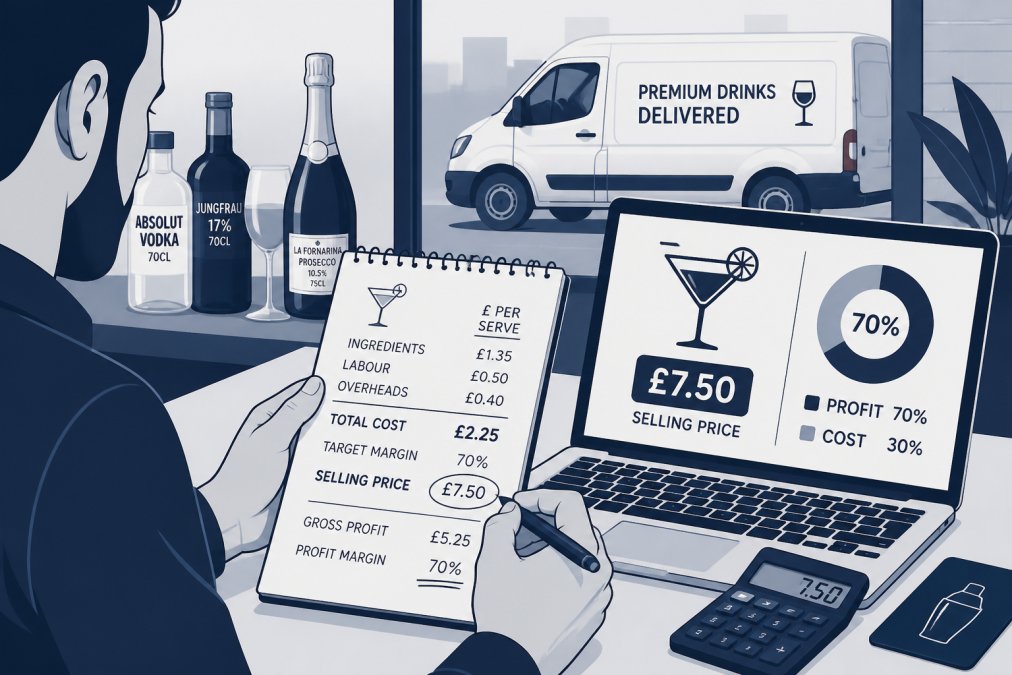
Start with your cost baseline. If a cocktail costs £1.50 in ingredients and you want an 80% gross margin, the minimum selling price is £7.50. But minimum isn't optimal. Your pricing should reflect ingredient cost, market positioning, and demand elasticity.
Market positioning matters enormously. A high-end cocktail bar in a premium location can charge £12-15 for a craft cocktail. A casual pub in a working-class area might price identical drinks at £5.50-£7.00. Your venue's positioning determines your pricing ceiling.
Demand elasticity tells you how sensitive customers are to price changes. Premium cocktails with strong brand recognition are less elastic; customers expect to pay more. Experimental or seasonal cocktails are more elastic; customers are more price-sensitive.
Price your core classics to support your margin targets, then use premium pricing on signature cocktails where demand is strong. A venue might price a basic vodka and tonic at £6.00 but charge £9.50 for a house signature cocktail using premium spirits like Absolut Vodka or Bombay Sapphire Gin.
Test price increases carefully. Raise prices by 50p on a slow night and measure volume impact. The sweet spot is usually a 7-10% price increase with 2-5% volume loss, resulting in net profit growth.
Track your actual selling prices against your target margins monthly. If a cocktail is consistently underperforming, either raise the price, reduce the recipe cost by switching to a cheaper base spirit, or remove it from the menu.
Calculating cocktail profit margins transforms how you run your bar. The formula is simple, ingredient cost subtracted from selling price, but the discipline required to execute it properly separates thriving venues from those that struggle. Track your ingredient costs using real supplier prices, standardise your pour sizes, reduce wastage through active monitoring, and price based on margins rather than guesswork.
Swallow Drinks has supported independent venues across the region for over 40 years, and the ones that grow are those that understand their numbers. Whether you're sourcing premium spirits like Absolut Vodka and Bombay Sapphire Gin or building your house brand with House Vodka Kalinska, the profitability framework remains identical. Access competitive pricing on all spirits and mixers through our trade ordering platform at https://webtrade.swallow.uk.com/, where you can track costs in real time and make pricing decisions based on actual supplier data rather than estimates.
Most bars target a gross profit margin of 70-85% on cocktails, which translates to a pour cost of 15-30%. This range allows you to cover labour, utilities, rent, and other operating expenses whilst maintaining healthy net income. Your specific target depends on your venue type, location, and customer base. High-volume nightclubs may operate at the lower end, whilst premium gastropubs often achieve margins above 80%. Track your actual margins monthly against industry benchmarks to stay competitive.
Divide the bottle cost by the total millilitres. For example, a 70cl bottle of Bombay Sapphire Gin at £21.70 contains 700ml, so the cost per ml is £21.70 ÷ 700 = £0.031 per ml. If a standard measure is 25ml, that spirit costs £0.78 per serve. This calculation forms the foundation of your ingredient costing. Always use the exact bottle size and price you pay your supplier to ensure accuracy. Swallow Drinks provides transparent pricing so you can calculate these figures with confidence.
Yes, significantly. Garnishes, citrus, ice, herbs, and decorative elements, are hidden costs that many bar managers underestimate. A lime wedge might cost £0.05-£0.10, ice £0.02-£0.05 per serve, and specialty garnishes £0.15-£0.30. Across 200 cocktails per week, garnish costs add £20-£70 to your weekly expenses. Build garnish costs into your recipe costing, not as an afterthought. Review your garnish sourcing regularly and consider which garnishes truly differentiate your menu versus those you can simplify.
Review pricing at least quarterly, or whenever your supplier costs change significantly. Ingredient prices fluctuate with seasonality and market conditions, affecting your pour cost and margin. If your cost of goods sold rises by 10%, your profit margin shrinks unless you adjust menu prices. Use POS data to identify which cocktails sell best and which underperform, then adjust pricing or recipe accordingly. Many successful bar operators review their menu engineering monthly to stay ahead of cost inflation and maintain target margins.
Members of:


AWRS Registration Number: XJAW00000100730