Jul 29, 2026
Last Updated: July 29, 2026
Hotel drink stock management is the systematic approach to tracking, controlling, and optimising drinks stock across your property. Effective management balances guest satisfaction, operational efficiency, and profitability. The drinks sector represents one of the highest shrinkage categories in hospitality, with waste and theft accounting for significant losses. The real opportunity lies in implementing systems that give visibility into what's happening at every stage, from delivery through to the guest's glass.
Effective drink stock management directly impacts cost of goods sold (COGS), guest experience, and operational control. A mid-sized hotel with a 100-bottle wine list can easily lose 8-15% of stock value annually through untracked breakage, over-pouring, spillage, and theft. For a property with £40,000 annual drinks spend, that represents £3,200-6,000 in preventable loss. Implementing proper stock control typically recovers 40-60% of that waste within six months.
Stock visibility changes how your team operates. Bar staff know exactly what's available. Managers spot trends in what sells and what sits untouched. This intelligence feeds directly into purchasing strategy and menu planning, strengthening your position with suppliers like Swallow Drinks.
Proper stock control begins with establishing clear baseline measurements and maintaining consistent tracking discipline. The fundamentals are straightforward to implement but require commitment to the process.
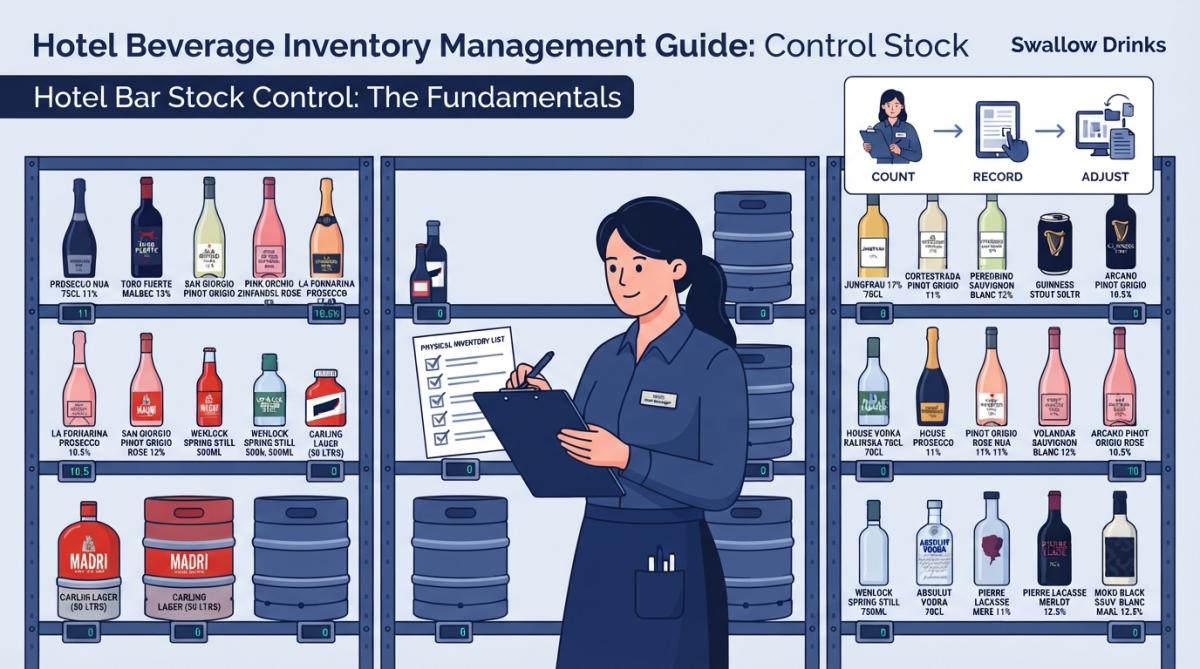
Par levels define the minimum quantity of each drink you maintain on hand at all times. Calculate par levels based on weekly consumption data. If your hotel sells 12 bottles of house wine per week and your supplier delivers twice weekly, your par might be 15-18 bottles to account for variance and delivery delays.
Reorder points sit slightly below par level. When stock reaches this threshold, you place an order immediately. Many operators set reorder points at 30-40% of par level, enough to cover lead time without unnecessary overstocking. Integration with your Point of Sale (POS) system removes guesswork and ensures consistency through automated alerts.
Real-time tracking means recording every bottle movement as it happens: purchases, usage, waste, transfers between bars or outlets. This creates an audit trail revealing exactly where drinks go. Most hotels conduct full reconciliation monthly, with spot checks weekly on high-value items.
The reconciliation process is straightforward: count physical stock, compare to system records, investigate variances. Variances above 2-3% warrant investigation, typically indicating data entry errors, unrecorded waste, or theft. Weekly reconciliation on premium spirits catches problems quickly; monthly reconciliation on standard stock is usually sufficient.
Drink shrinkage, the gap between what you purchased and what generated revenue, is the silent profit killer in hospitality. Shrinkage comes from legitimate waste (spillage, breakage, spoilage) and illegitimate loss (theft, over-pouring, unrecorded consumption).
Common sources of shrinkage include over-pouring (a 50ml spirit should be 50ml, not 60ml), spillage and breakage, evaporation and oxidation of opened bottles, unrecorded consumption, and theft. Prevention starts with standard operating procedures defining exact pour sizes for every drink and staff training on proper technique.
For opened bottles, establish a clear policy: opened wine is consumed within 24 hours or discarded. Opened premium spirits are tracked and rotated. Many operators allocate 1-2% of sales as allowable waste; anything above that triggers investigation. Implement spot checks where managers verify pour sizes during service.
Establish a waste log recording every bottle discarded, every spoiled product, every spill. Categorise waste: spillage, breakage, oxidation, spoilage. Over time, patterns emerge identifying improvement opportunities. Working with a reliable supplier like Swallow Drinks who can deliver frequently in smaller quantities reduces pressure to buy in bulk, which reduces waste and improves cash flow.
Digital stock management systems transform drink control from manual work into efficient, automated processes, giving real-time visibility into stock levels, usage patterns, and profitability by drink.
The power of stock software emerges when it integrates seamlessly with your existing systems. Your POS system records every drink sold; stock software automatically deducts from stock. When a guest orders house wine, the system automatically updates stock levels, creating a live, accurate picture of what's on hand.
Property Management System (PMS) integration adds another layer. Your PMS knows which rooms are occupied and which events are scheduled, allowing stock software to forecast demand. A 200-person conference generates different drinks demand than a quiet Tuesday night. Real-time integration prevents lag time of manual entry, reducing both errors and administrative burden.
Demand forecasting uses historical sales data to predict future needs. If your data shows Saturdays drive 40% higher spirits sales than Wednesdays, the system can forecast what you'll need next week based on your calendar and historical patterns.
Automated ordering generates purchase orders when stock reaches reorder points, ready for your approval. For properties using Swallow Drinks as your supplier, automated ordering through their trade platform at swallow.uk.com simplifies the entire process. Set par levels and reorder points once; the system handles the rest.
Your purchasing decisions ripple through every aspect of drink management. Buy strategically and you create a portfolio balancing profitability with guest appeal.
The relationship with your drinks supplier matters far more than most operators realise. A reliable supplier ensures consistent availability, competitive pricing, and product knowledge informing your menu decisions. Swallow Drinks, as a family-run independent wholesaler with over 40 years of industry experience, understands the on-trade sector across the UK. We combine a vast portfolio of premium wines, beers, spirits, and soft drinks with the flexibility independent venues need.
Reliability means understanding your business challenges and helping solve them. A good supplier helps navigate seasonal demand shifts, suggests products matching your market, and supports menu innovation without pressure to overstock. When evaluating suppliers, consider delivery frequency, product range, pricing transparency, and service quality. Swallow Drinks delivers consistently across Birmingham and surrounding areas, with the scale to source niche local labels and craft beers alongside mainstream brands.
Premium wines, rare spirits, and vintage selections require different management than standard stock. Implement stricter controls: lock storage areas, limit access to trained staff, track every bottle individually, and conduct more frequent reconciliation. Weekly or daily tracking for items over £50 per bottle is justified by the risk.
Vintage wines require proper storage conditions (temperature, humidity, position). Some operators track vintage stock separately from operational stock, treating it as an asset rather than consumable stock. Staff training is critical, your team needs to know which bottles justify premium pricing and how to handle them properly.
Metrics transform gut feelings into objective reality. The right KPIs tell you whether your drink operation is healthy or heading toward problems.
Stock turnover measures how quickly you convert stock into sales. Calculate it as: Cost of Goods Sold (COGS) divided by Average Stock Value. If your annual drinks COGS is £40,000 and your average stock value is £8,000, your turnover is 5 times per year.
Higher turnover indicates efficient operations; stock moves quickly, reducing waste and spoilage. Lower turnover suggests slow-moving items tying up capital. Benchmark your turnover against industry standards (typically 4-8 times annually for hotels).
COGS percentage is equally important. Calculate it as: Total Drinks COGS divided by Total Drinks Revenue. Industry standards vary: fine dining typically runs 28-35%, casual bars 30-40%, hotels 35-45%. Monitor these metrics monthly. Trends matter more than single months. A rising COGS percentage might indicate supplier price increases, higher waste, or menu mix shifts.
These practices reflect what actually works in live hotel operations.
SOPs eliminate guesswork and create consistency. Your SOP should document par levels for every drink, reorder points and ordering procedures, reconciliation frequency and process, pour sizes and measurement standards, waste documentation, access controls for premium stock, and training requirements.
Review and update your SOP quarterly. As you gather data on what actually moves, adjust par levels. As you identify new waste sources, add preventive measures. Document your SOP in writing, distribute it to all relevant staff, and train new hires on it before they work independently.
Monthly full reconciliation is standard practice. Conduct it consistently on the same day each month using a checklist covering all spirit bottles, wine bottles, beer and cider stock, soft drinks and mixers, opened bottles with usage notes, and stock held in multiple locations.
After physical count, compare to system records and investigate variances above 2-3%. Quarterly spot audits on high-value items catch problems between full reconciliations. Select 5-10 premium items randomly, count them, and compare to system records. Annual deep audits review your entire process: are par levels still appropriate, has your business mix changed, are staff following procedures?
Audit Type | Frequency | Focus | Time Required |
|---|---|---|---|
Full reconciliation | Monthly | All stock | 2-3 hours |
Spot audit (premium items) | Quarterly | High-value bottles | 30 minutes |
Annual deep audit | Annually | Process and systems | 4-6 hours |
Drink stock management separates profitable hotel operations from those bleeding margin through waste and inefficiency. The challenge isn't complexity, it's consistency. Par levels, reconciliation, waste tracking, and KPI monitoring are straightforward practices requiring systematic implementation and sustained effort.
Swallow Drinks supports your drink operation with over 40 years of industry experience, a vast portfolio of premium wines, beers, spirits, and soft drinks, and reliable service across Birmingham and surrounding areas. Our trade ordering platform at swallow.uk.com integrates with your purchasing workflow, simplifying the ordering process and helping you maintain optimal stock levels. When you partner with a supplier who understands hospitality, your entire drink operation becomes more efficient.
Effective hotel drink stock management combines regular physical counts with digital tracking systems. Set par levels for each product, conduct weekly stocktakes, use real-time tracking via POS integration, and implement clear standard operating procedures. Partner with a reliable supplier like Swallow Drinks—with over 40 years' experience serving the on-trade sector—to ensure consistent stock availability and transparent pricing without hidden surcharges.
Most hotels benefit from weekly stocktakes for high-turnover items and monthly full audits for the entire drink portfolio. High-value or vintage stock should be counted more frequently—sometimes weekly—to prevent shrinkage. Regular audits create an audit trail essential for identifying discrepancies, managing cost of goods sold (COGS), and maintaining accurate par levels. Digital stock systems make this process faster and more reliable.
Reduce shrinkage by implementing strict access controls, training staff on proper pouring techniques, tracking spillage and waste, and conducting regular stock audits. Sustainability tracking helps identify patterns—for example, which products have higher waste rates. Use demand forecasting to avoid over-ordering obsolete stock. Real-time tracking via POS systems reveals discrepancies immediately, and working with experienced suppliers helps optimise stock levels to match actual demand.
Choose software that integrates with your POS system and Property Management System (PMS) for seamless data flow. Look for real-time tracking, automated ordering capabilities, demand forecasting, and detailed audit trails. The system should support par-level management, calculate drink cost percentages, and generate KPI reports on stock turnover and COGS. Ensure it's designed for UK hospitality standards and offers reliable supplier management features to streamline your ordering process.
Members of:


AWRS Registration Number: XJAW00000100730