Jul 21, 2026
Last Updated: July 21, 2026
Transparency in wholesale drinks pricing is critical to running a profitable on-trade business. Whether you're managing a bar, restaurant, or independent venue, understanding how pricing directly impacts your bottom line is essential. Many distributors obscure their true costs behind bundled pricing, hidden surcharges, and vague delivery fees. This article walks you through seven essential wholesale drinks pricing transparency tips that will help you take control of your costs, negotiate with confidence, and build a sustainable relationship with your supplier.
Negotiation begins with information. You cannot negotiate effectively without understanding what you're actually paying for. The first step is always to ask for an itemised quote upfront: a detailed breakdown showing unit cost, volume discounts, delivery charges, and any surcharges specific to your account.
An itemised quote is your foundation for drinks pricing transparency. Rather than accepting a single total figure, insist that your supplier provides a line-by-line breakdown showing the cost per unit for each product, the quantity you're ordering, any volume-based discounts applied, and all additional charges including delivery, handling, and packaging.
Bundled pricing hides the real cost of individual products. A supplier might offer a "competitive package" that includes premium spirits at reasonable rates but charges inflated prices on soft drinks or mixers. Without itemisation, you won't spot this cross-subsidy until you've already committed to the deal.
When requesting a quote, specify exactly what you need: product name, bottle size, unit price, minimum order quantity, bulk discount thresholds, delivery cost per order, and any surcharges for special requests. Ask whether pricing changes seasonally, as many suppliers adjust rates for peak trading periods.
Your cost of goods sold (COGS) is the total amount you pay your supplier for a product, including the unit price plus your share of delivery and handling costs. Understanding your COGS is fundamental to calculating your profit margin and setting retail prices that generate revenue.
The wholesale markup formula is straightforward: Retail Price = COGS ÷ (1 − Desired Profit Margin). If your COGS for a bottle of spirits is £8 and you want a 65% profit margin, your retail price should be £8 ÷ (1 − 0.65) = £23. This ensures your business covers operating expenses and leaves genuine profit.
Many venues underestimate their true COGS because they forget to factor in delivery, packaging, and breakage. If you're paying £50 for a case of 12 bottles at £4 per unit, but delivery adds £5 per order, your actual COGS per bottle is slightly higher than the unit price suggests.
Suppliers use different pricing structures. The most common models are flat-rate pricing (same unit cost regardless of volume), tiered pricing (lower cost per unit as you order more), and cost-plus pricing (supplier's cost plus a fixed markup percentage).
Tiered pricing rewards larger orders with lower per-unit costs. If your supplier offers pricing at 1-5 cases, 6-10 cases, and 11+ cases, you need to understand the cost difference at each tier and whether ordering in larger quantities actually saves money after accounting for stock holding costs.
For example, if you're paying £50 per case at the 1-5 tier but £48 per case at the 6-10 tier, ordering six cases instead of five saves you £2 per case on the sixth item, a 4% saving. But if you're holding excess stock that expires or takes up valuable space, that saving disappears. The key is finding the sweet spot where bulk discounts outweigh carrying costs.
Work with your supplier to map out a tiered pricing schedule for your top 10-15 products. Ask whether they offer volume commitments; some suppliers will lock in a lower rate if you commit to ordering a minimum amount monthly, providing both parties with predictability.
Beyond unit price and delivery, suppliers often add fees you won't see unless you ask: surcharges for small orders, rush deliveries, split cases, returns of damaged stock, and administrative charges for custom orders.
A "cost of doing business" fee is sometimes added to accounts perceived as high-maintenance. These fees are negotiable. If your supplier is charging you a £15 administrative fee per month, ask what triggers it and whether you can eliminate it by committing to a minimum order value.
Packaging costs are another hidden expense. Some suppliers charge separately for branded packaging or custom labels. Request a separate line item showing packaging costs so you know exactly what you're paying.
True drinks pricing transparency means your supplier proactively communicates price changes, explains the reasoning behind them, and gives you advance notice before adjustments take effect.
A price posting management system makes pricing visible and updateable in real time. This could be a supplier's online portal where you log in to see current pricing, a shared spreadsheet, or dedicated price management software that tracks historical pricing and alerts you to changes.
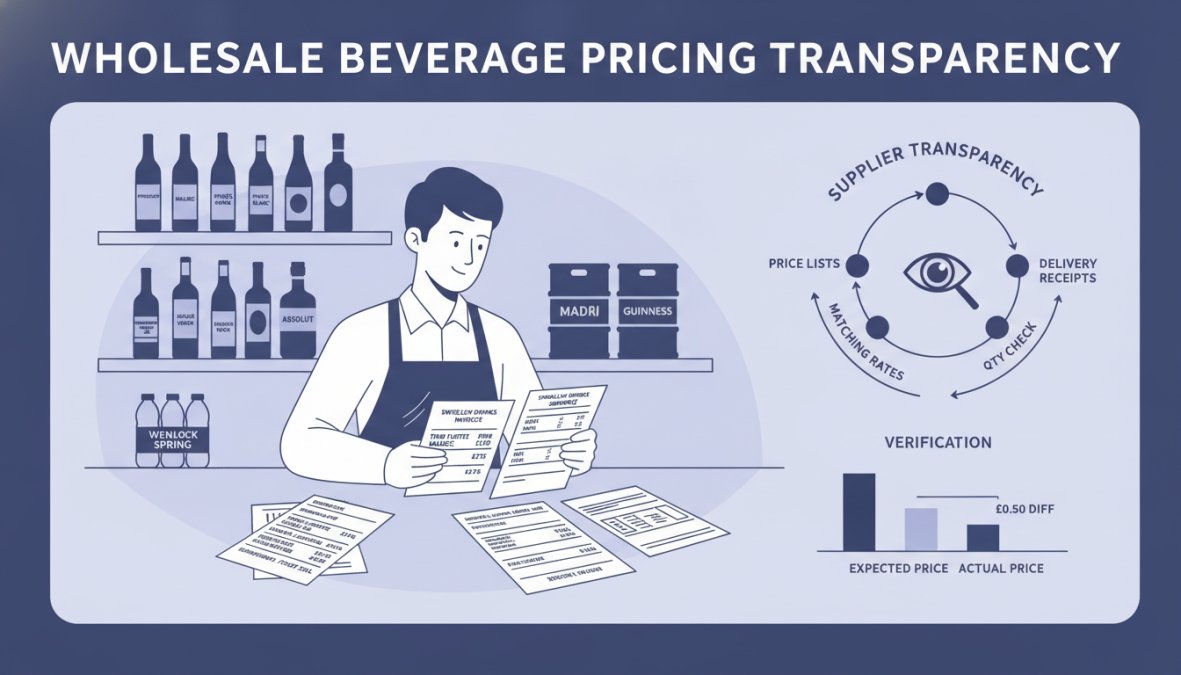
The best systems show you not just current prices but also historical trends. You should be able to see whether a price increase is a one-off adjustment or part of a longer trend. Ask your supplier whether they offer a price management portal or whether pricing information is available only via email or phone. A transparent supplier will have a system in place and will proactively notify you of changes.
Clear communication protocols prevent misunderstandings and build trust. Establish a regular cadence for pricing reviews, monthly or quarterly calls where you and your supplier discuss upcoming price changes, market conditions affecting costs, and opportunities to adjust your product mix.
During these conversations, ask your supplier to explain the drivers behind price changes. Are they passing through cost increases from their own suppliers? Are they adjusting for seasonal demand? Understanding the reasoning helps you decide whether to absorb the increase, adjust your retail pricing, or switch to alternative products.
Document everything in writing. If your supplier verbally promises a discount or waives a fee, follow up with an email confirming what was agreed.
As your business grows, predicting demand and planning purchases become critical. Predictive pricing uses historical sales data and forecasting to anticipate what you'll need, allowing you to take advantage of bulk discounts and avoid stock-outs.
Your point-of-sale (POS) system holds the data you need to forecast demand accurately. By analysing sales patterns, which products sell fastest, and which seasons drive volume, you can project future needs and plan orders strategically.
Extract your POS data monthly and calculate the average weekly sales for each product. If you sell 15 bottles of house spirit per week on average, you know you need roughly 60 bottles per month. This lets you approach your supplier with a realistic forecast and negotiate tiered rates for that volume.
Forecasting also helps you identify slow-moving stock. If a product you ordered in bulk isn't selling, you'll see it in the data and can adjust future orders before cash gets tied up in dead stock.
Once you understand your COGS through itemised invoicing and your sales volume through POS analysis, you can optimise your profit margins strategically. Not all products should carry the same margin; premium spirits might support a 70% margin while house wines might be 50% to drive volume.
Use your POS data to identify your highest-margin and highest-volume products. These are your profit drivers. Ensure your supplier relationship prioritises these items and negotiate better pricing on them.
Hidden fees erode margins silently. Every fee should be negotiable and justified.
Minimum order fees are charged when your order falls below a threshold, typically £100-200. Some suppliers waive this for regular customers. Ask whether you can earn a waiver by committing to a minimum monthly spend.
Split case fees penalise you for ordering fewer than a full case. This discourages small orders but can be negotiated away if you're a consistent customer.
Delivery surcharges apply to orders below a certain value or to locations outside the primary service area. Request a flat delivery rate or negotiate free delivery above a certain order value.
Packaging costs for branded boxes or custom labelling should always be itemised separately. Don't pay a blanket "packaging charge"; insist on seeing exactly what you're paying for.
VAT is standard across UK suppliers, but some products carry different rates. Spirits and wine are subject to excise duty in addition to VAT, which varies by product type and alcohol content. Understand how your supplier calculates tax on each product category.
Some suppliers charge a "compliance surcharge" claiming it covers their costs for age verification systems or staff training. Under UK alcohol licensing regulations, these are typically the retailer's responsibility. Challenge any compliance-related fees and ask for documentation showing what they cover.
Fee Type | Typical Cost | Negotiable | How to Challenge |
|---|---|---|---|
Minimum order fee | £15-50 per order | Yes | Request waiver for regular accounts |
Split case surcharge | £1-3 per bottle | Yes | Commit to full-case orders |
Delivery surcharge | £5-15 per order | Yes | Negotiate flat rate or free above threshold |
Packaging charge | £2-10 per case | Yes | Request itemisation and justification |
Rush delivery | £20-50 per order | Yes | Plan orders in advance to avoid |
Returns/damage fee | Variable | Yes | Clarify damage responsibility upfront |
Understanding pricing is one thing; implementing systems to track and manage it is another. Without processes, transparency quickly becomes opaque again.
The supplier you choose sets the tone for pricing transparency in your business. Look for suppliers who offer itemised invoicing as standard, provide access to a pricing portal or management system, and communicate proactively about price changes.
When evaluating suppliers, ask these questions: Do they provide itemised invoices automatically? Do they have a system for managing pricing information? Are they willing to lock in rates for committed volumes? Do they explain price changes before implementing them? A supplier who answers yes to all these questions is worth partnering with.
Consider registering with a trade ordering platform to access real-time pricing, manage your account online, and maintain full visibility of your costs. This level of transparency should be standard practice, not an add-on.
Implement a simple spreadsheet or dedicated software that tracks your supplier's pricing over time. List your top 20 products with their current unit cost, delivery cost, total COGS, and your retail price. Update this monthly as prices change.
This shows you immediately when a price increase occurs and creates a historical record you can reference during negotiations. If your supplier claims a price increase is necessary due to market conditions, you can pull up data showing what you paid six months ago and challenge whether the increase is justified.
Link your price management system to your POS data so you can see the relationship between cost and sales volume. For draught products and house spirits, your highest-volume items, track pricing weekly. Even small cost changes compound quickly across large volumes.
Wholesale drinks pricing transparency isn't a luxury, it's a necessity for venues serious about profitability. Hidden fees, unclear markup structures, and poor supplier communication drain margins silently.
The strategies outlined here, requesting itemised quotes, understanding markup formulas, implementing price management systems, and building transparent supplier relationships, work because they shift power back to you. You stop being a passive buyer accepting whatever terms are offered and become an informed negotiator who understands the true cost of every product.
Start by requesting itemised quotes from your current supplier. If they push back or claim that level of detail isn't available, that's your signal to explore alternatives. Transparency isn't negotiable; it's the foundation of a sustainable supplier relationship.
Request itemised quotes that break down unit costs, packaging, and delivery separately. Compare quotes from multiple suppliers and ask about volume discounts. Be transparent about your pour costs and profit margins—professional suppliers respect this. Document all agreed prices in writing and establish a regular review schedule. Consider joining a trade area like Swallow's WebTrade platform to access competitive pricing and understand market rates in your region.
Common hidden costs include delivery surcharges, minimum order fees, promotional contributions, and packaging markups. Always request a full cost breakdown before committing. Ask specifically about regional tax variations and whether prices include duty or excise tax. Reputable suppliers like Swallow Drinks provide transparent pricing with no surprise amendments. Request a price posting management system that shows all fees upfront, so your COGS calculations remain accurate.
Distributors typically use tiered pricing based on bulk purchasing volumes. Understanding your drinks cost percentage and pour costs helps you negotiate better rates. For example, buying Bag In Box syrups like Coca-Cola 7Ltr at £79.85 allows you to calculate exact unit costs and forecast profit margins. Use POS system data to analyse which drinks drive the highest gross profit, then negotiate better rates on those bestsellers with your supplier.
Transparent suppliers help you forecast accurately, manage cash flow, and optimise your drinks program. Clear pricing prevents disputes and allows you to plan menu changes confidently. Suppliers who communicate openly about market rates, regulatory compliance, and price amendments build trust. For independent bars and small venues, working with a family-run wholesaler like Swallow Drinks—with 40 years of experience—ensures you receive honest advice on pricing, stocking decisions, and compliance with UK liquor authority regulations.
Members of:


AWRS Registration Number: XJAW00000100730