Jul 13, 2026
Last Updated: July 13, 2026
Weekend inventory mismanagement directly impacts profitability. High transaction volume, service speed, and staff pressure create perfect conditions for stock discrepancies and shrinkage. A single miscounted case multiplies across dozens of transactions. Unlike weekdays where errors are caught incrementally, weekends compress chaos into 48 hours with higher staff turnover and increased opportunity for mistakes and theft.
This guide covers strategies that work: establishing consistent schedules, using checklists for accuracy, reducing shrinkage, implementing software solutions, and reconciling stock immediately after peak service. Businesses that get this right prevent losses and improve pour costs.
Consistency beats perfection. A predictable schedule means staff know exactly when counts happen and compliance improves.
Begin your weekend on Thursday or Friday afternoon. Establish par levels for every stock category before the rush starts. Par levels represent the minimum quantity needed to serve customers through Sunday night.
Calculate par levels based on historical sales data. If your venue sells 40 cases of lager per weekend, set par at 45-50 cases to account for variance. Review these numbers quarterly as seasonal demand shifts. Document par levels in a spreadsheet or stock management system and assign a manager to verify stock against par before service begins.
During Friday and Saturday service, assign one person per shift to monitor stock levels every 2-3 hours. When high-volume items approach critical levels, flag them to management. Document these spot checks with time, product, quantity, and staff member. This creates accountability and reveals patterns.
A physical or digital checklist is your most powerful tool for accuracy. It removes guesswork and creates an audit trail.
Your checklist must include: product name and category (list every product separately, distinguishing between draught and bottled), unit of measure (bottles, cases, kegs, or ounces), par level, actual count, counted by (signature for accountability), date and time, and variance notes explaining discrepancies.
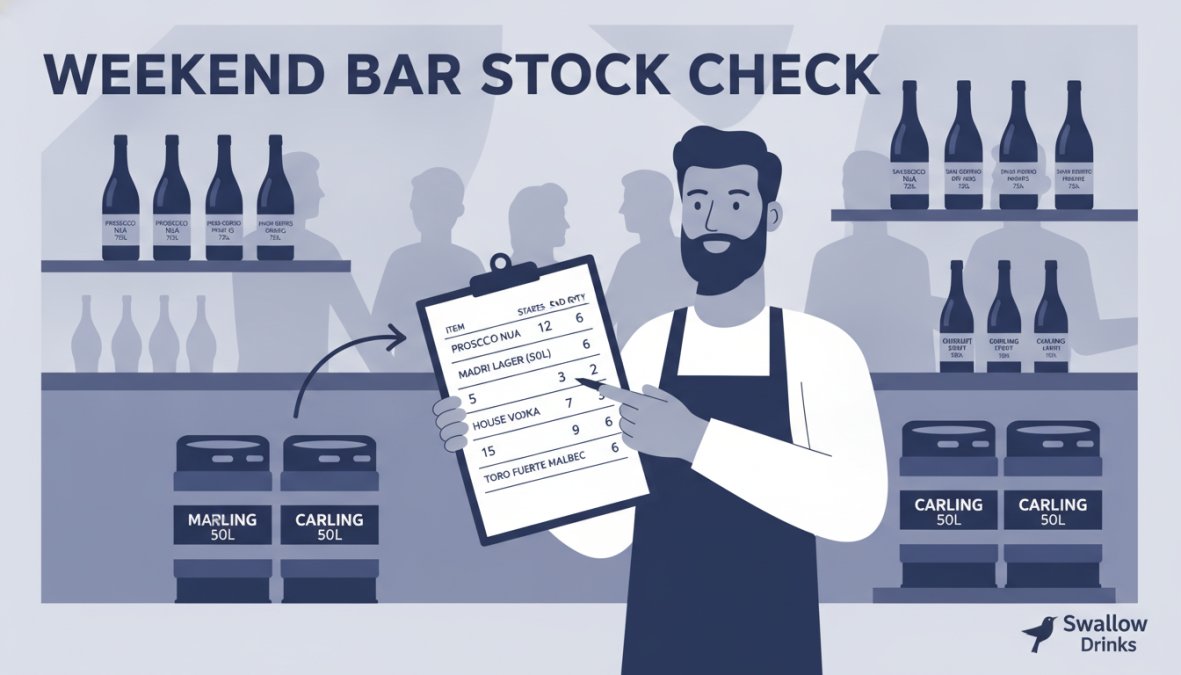
Unit confusion is the biggest source of inventory error. Establish a standardized unit system: draught beer in kegs and litres remaining, bottled beer in cases and individual bottles, spirits in full bottles and partial bottles (note the level), wine in full and opened bottles, soft drinks in cases. Print this standard on every checklist and train all staff on it. For partial bottles, estimate the percentage remaining.
Shrinkage is the difference between recorded and actual stock. On weekends, shrinkage can spike from normal 2-3% to 5-8% without proper controls.
Implement a simple rule: no one takes anything without written manager permission. Use CCTV behind the bar during service, visible cameras reduce opportunistic theft significantly. Monitor till transactions closely; every drink poured should have a corresponding sale recorded. Require managers to sign off on all voids and discounts above a threshold (e.g., £5).
Train bartenders on precise pouring. A 25ml measure should be exactly 25ml, not 30ml. Overpouring by 5ml across 200 drinks per weekend is 1 full litre of spirits lost. Use pour spouts on all bottles and consider automated pourers that dispense exact measures. For draught beer, train staff on proper pouring technique to the line, not overflowing with foam. Rotate stock using FIFO (first in, first out) and check expiration dates weekly.
Manual counting works, but software gives real-time visibility and reduces human error. The best systems integrate with your POS to show actual sales against stock levels.
Modern bar stock software connects directly to your POS. Every drink sold is automatically logged. At weekend's end, the system shows exactly how many units of each product should have been consumed based on sales data. When you conduct your physical count and compare it to POS data, discrepancies become obvious. Set up your software to flag variance automatically, if stock is more than 5% off from expected, investigate immediately.
When every transaction is logged and every count is tracked, staff know they're accountable. Use your software to generate individual shift reports showing bartenders how much they sold, their pour costs, and any discrepancies. Most staff are honest and take pride in accuracy. For problem areas, use the software to coach rather than punish.
Pour cost is the percentage of revenue that goes toward the cost of goods sold. Understanding this metric transforms how you manage inventory and pricing.
Pour cost is calculated as: (Cost of Stock Used ÷ Revenue from Drinks Sales) × 100
If you used £1,000 of stock over the weekend and generated £4,000 in drink sales, your pour cost is 25%. Industry standard is 20-28%, depending on venue type and pricing strategy. Calculate this weekly. If pour cost creeps above 30%, you've got a problem: shrinkage, overpouring, pricing that's too low, or expensive stock choices.
Sunday evening or Monday morning, conduct full reconciliation. Compare your physical count to POS data and calculate the variance percentage. A variance of 2-3% is acceptable and normal. Anything above 5% needs investigation. Document your findings in a simple report showing expected stock, actual stock, variance percentage, likely causes, and actions taken.
Reconciliation turns raw data into actionable insight and catches systemic problems before they become expensive habits.
Start with your POS data showing how many units of each product were sold based on transactions. Conduct your physical count using the same checklist. Compare the two numbers. If POS says 50 bottles of lager were sold and you're short 48 bottles, you're in good shape. A 2-bottle difference is normal variance. If you're short 55 bottles, you've got a 5-bottle discrepancy needing explanation. Investigate: Did a delivery arrive that wasn't logged? Did someone do an off-the-books pour? Is there spillage or breakage unreported?
Once you've identified a pattern, act on it. If draught beer consistently shows 3-4% variance while spirits show 1-2%, improve your draught counting method. If a particular bartender's shifts show higher variance, review their technique with them. If your POS is missing sales, investigate the till system. Document your corrective actions and review them after the following weekend.
Venues that excel at weekend stock management share common habits.
FIFO, first in, first out, is the gold standard for stock rotation. Date every delivery when it arrives and ensure staff grab the oldest date first. For draught beer, rotate kegs in the same order. Check for expired products weekly and remove them from service immediately.
Organize stock by category: spirits together, liqueurs together, mixers together, draught beer in one area, bottled beer in another. Use shelf labels that clearly identify what goes where. Keep your most popular products at eye level and within arm's reach.
Managing weekend stock effectively also means ordering efficiently during the week. Using a trade ordering system lets you place orders quickly and track deliveries, so you're never caught short on Friday afternoon. The easier your ordering process, the more time you can spend on inventory management and staff training.
| Best Practice | Implementation | Weekend Impact |
|---|---|---|
| Establish par levels | Calculate based on historical sales, set minimums, review quarterly | Prevents stockouts and overstocking |
| Use checklists | Create standardized forms with product, units, par level, actual count | Reduces counting errors by 80% |
| Implement POS integration | Connect stock system to till, flag variances automatically | Identifies shrinkage immediately |
| Train staff on units | Standardize how you count (cases, bottles, kegs, ounces) | Eliminates confusion and errors |
| Monitor in real-time | Assign staff to check stock every 2-3 hours during service | Prevents mid-service stockouts |
| Calculate pour costs | Track (cost of stock ÷ revenue) weekly | Reveals pricing and purchasing issues |
| Reconcile immediately | Compare POS to physical count within 24 hours | Catches problems while memory is fresh |
| Rotate stock with FIFO | Date all deliveries, use oldest first | Prevents waste and expired products |
Venues that implement structured weekend inventory processes see 15-20% improvements in stock accuracy and measurable reductions in shrinkage. The key is consistency: the same process every weekend with the same level of attention.
Managing bar stock during weekends isn't glamorous, but it's essential. Start with the basics: establish par levels, use a checklist, and reconcile every Monday morning. Add POS integration when ready. Train your staff on units of measure and hold them accountable. Streamline your ordering process so you can focus on what matters.
The investment in process pays dividends. A 2-3% improvement in shrinkage translates directly to bottom-line profit. Over a year, that's meaningful money that stays in your business instead of walking out the door.
Most bars benefit from a pre-weekend count (Friday afternoon) and a post-weekend reconciliation (Monday morning). High-volume venues may conduct brief mid-shift spot checks on Saturday and Sunday evenings to catch discrepancies early. Regular weekend stock audits help identify shrinkage patterns and prevent theft before losses mount. Using bar stock management software allows real-time tracking without disrupting service.
Implement bar stock management software integrated with your POS system for real-time visibility. Assign one staff member per shift to monitor par levels and log adjustments. Use standardised units of measure (bottles, ounces, cases) to ensure accuracy. Brief spot checks every 2-3 hours during peak periods catch issues early. Post-weekend reconciliation workflows comparing expected versus actual stock reveal variances for investigation and training.
Reduce bar shrinkage by establishing clear pour cost standards, monitoring staff accountability during high-volume shifts, and rotating stock using FIFO methodology to minimise dead stock. Implement POS integration to cross-reference drinks sold with stock dispensed. Secure expensive spirits in locked areas. Train staff on proper pouring techniques to reduce waste and spoilage. Regular variance analysis identifies unusual patterns that may indicate theft or mismanagement, allowing corrective action before the next weekend.
Pour cost is the percentage of revenue spent on drinks sold, calculated as total drinks cost divided by total drinks revenue. Typical targets range from 20-30% depending on your establishment. Tracking pour cost during weekends, when volume and staff pressure peak, reveals whether shrinkage, waste, or pricing issues are eroding profit. Post-weekend reconciliation and variance analysis help you adjust par levels, supplier orders, or staff training. Swallow Drinks supplies premium drinks at competitive prices, helping you maintain healthy margins.
Members of:


AWRS Registration Number: XJAW00000100730