Nov 15, 2026
Last Updated: November 13, 2026
Quick Summary
A private label drink is a product a manufacturer makes to your recipe and labels under your brand name, while you handle listings, stock and customer relationships. Most brands start with one product and add lines once sales are proven.
Private label drinks let a business sell its own brand without running a bottling line. Swallow Drinks, a family-run independent wholesaler with 40 years of experience in the drinks trade, sees the same question from new brand owners again and again: how does the product get made, and what does the online wholesale channel actually demand from it? The short answer is that a manufacturer produces the drink to your recipe and labels it under your name, while you handle the listings, stock and customer relationships.
A production partner typically covers formulation, sourcing, blending, bottling or canning, and packing. Your role is to set the specification, approve samples and agree the packaging.
Most small brands start with a single product, such as a ready-to-drink mixer or a own-label wine, and add lines once sales are proven. Contract wine work is a good example: a range of UK wine labelling and trade guidance applies to the bottle, so check the label content against official requirements before printing.
Watch out: a sample that tastes right in a small batch can drift once it is scaled up, so ask for a production sample from the actual run before signing off.
Choosing the right manufacturer shapes everything that follows, so compare options against a fixed set of criteria rather than price alone. The checklist below covers the points that matter most for online wholesale, but a tick-box approach is not enough. You need to ask specific questions and understand the trade-offs behind each answer.
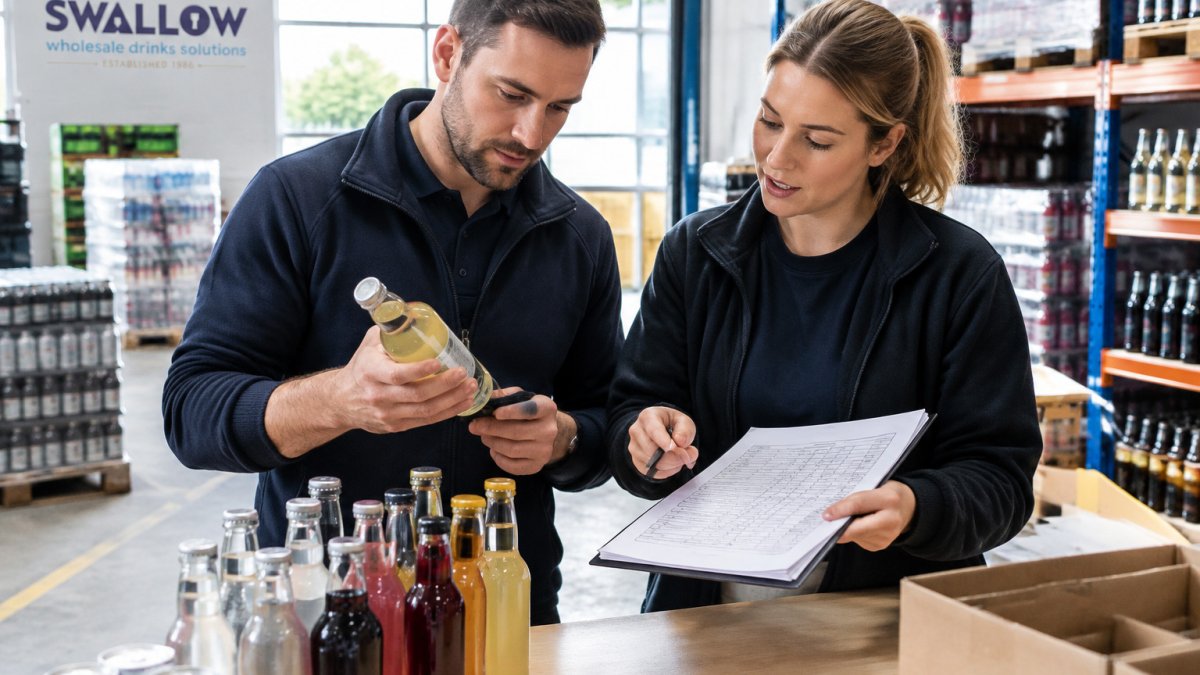
Start with capacity and scheduling. Ask how many production runs they handle per week and whether they can accommodate your forecast volumes without pushing you to the back of the queue. A supplier that is busy with large contracts may deprioritise smaller orders, so get a written commitment on lead times and ask what happens if a dry goods shipment (bottles, cans, labels) is delayed.
Quality systems are non-negotiable. Request their food safety certifications and ask to see the most recent audit report. For drinks sold online, you also need assurance on batch consistency: ask how they sample and test each run, and whether they retain a reference sample from every batch. If they cannot explain their quality control process in plain terms, walk away.
Ownership of recipes and labels is a common trap. Confirm in writing that you own the formulation and the artwork, and that the supplier will not reuse your recipe for another client. Some manufacturers insist on owning the recipe if they develop it, so clarify this before any development work begins.
Ask for references from brands at a similar scale to yours, and follow them up. Also ask about their experience with online wholesale specifically: can they supply products with the barcodes, case configurations, and product data you need for trade listings? Swallow Drinks has 40 years of experience in the drinks trade and understands these requirements first-hand. You can see how product detail is presented for trade buyers by browsing our customers own label wine range, and our wine merchants and shippers service shows how trade supply works alongside own-label production.
Finally, ask about exit terms. What happens if you want to move production elsewhere? Will they hand over the full specification and supplier contacts for packaging? A good supplier will be transparent about this, and a bad one will try to lock you in.
Watch out: a supplier that cannot provide a clear answer on recipe ownership or quality auditing is a risk you cannot afford when building a brand for online sale.
A clear recipe brief saves time and money. Write down the flavour profile, the alcohol or sugar level, the target retail price and the container format before you request quotes. For wine, the back label is often the first point of contact with a buyer, so the design and the legal information on it need as much attention as the liquid.
Packaging choices affect both cost and shelf appeal. Cans suit ready-to-drink products and are easy to ship. Glass suits premium wine and spirits. Each format has its own minimum runs and label specifications, so confirm them early.
Swallow Drinks offers own-label wine options, including back label chilean merlot and back label chilean sauv blanc in 75cl bottles, which shows how a basic wine can be given a distinct identity through labelling. Explore our wine merchants and shippers service for how trade supply works alongside own-label production.
Labels on drinks sold online must carry the information UK law requires, and that information must be visible on the product listing as well as the bottle. Check the mandatory content against current UK food labelling rules and the rules that apply to alcohol strength and volume. Drinks with alcohol must state the alcohol by volume (ABV) and the net volume, and these figures should match across the label, the product page and any trade price list.
Keep a single master file of label text for each product. When you update a recipe or change a supplier, that file tells you exactly which listings need changing.
Minimum order quantities vary by manufacturer and by format. A bottling run usually has a higher MOQ than a short run of canned product, and dry goods such as printed bottles or cans often set the floor. For online wholesale, you also need to consider case quantities and pallet configurations, because these affect your storage and shipping costs. Ask for the unit cost at two or three order sizes so you can see how the price per bottle changes, and request a sample case to check that the packaging survives transit.
Build a simple cost sheet before you commit. Include the liquid, packaging, labelling, packing, storage and delivery to your fulfilment point. For online wholesale, add the cost of platform fees (if you sell through a marketplace), payment processing, and any pick-and-pack charges. Compare that total against your target wholesale and retail prices, and keep a margin for returns and damaged stock. Quote every figure in GBP so the numbers are easy to compare with trade price lists.
Unit economics are where many new brands come unstuck. A common pattern is to focus on the manufacturing cost per unit and forget the downstream costs. You need to know your break-even volume: how many cases you must sell per month to cover your fixed costs (storage, insurance, platform subscriptions) before you make a profit. Build a buffer into your break-even estimate.
Swallow Drinks offers own-label wine options, including back label chilean merlot and back label chilean sauv blanc in 75cl bottles, which shows how a basic wine can be given a distinct identity through labelling. Our customers own label wine range gives you an idea of the product detail you should expect, and our wine merchants and shippers service explains how trade supply works alongside own-label production. To access wholesale pricing and place orders, register for a trade account at Swallow Drinks trade ordering.
Watch out: a low MOQ can be misleading if the unit cost is high. Always calculate the total cost of ownership, including storage and fulfilment, before choosing a supplier.
| Stage | Typical actions | Approximate timing |
|---|---|---|
| 1. Brief | Define recipe, format, price and volume | 1 to 2 weeks |
| 2. Shortlist | Request quotes from 3 to 5 manufacturers | 2 to 3 weeks |
| 3. Samples | Approve development samples and packaging | 3 to 6 weeks |
| 4. Labels | Finalise artwork and legal information | 1 to 2 weeks |
| 5. Production | Run the approved order and quality check | 4 to 8 weeks |
| 6. Listing | Load product pages and stock levels online | 1 to 2 weeks |
Timings depend on the supplier and on dry goods lead times, so treat these as planning estimates. Build a small buffer into every stage.
Once your recipe, supplier and label are agreed, the next step is getting your stock into trade channels. Register for a trade account at Swallow Drinks trade ordering to access wholesale pricing and place orders for the drinks you need to launch. Our team can talk you through the options, so you can move from brief to first order with confidence.
A private label drinks arrangement means a manufacturer produces the drink to your specification, and you sell it under your own brand. You provide or agree the recipe, packaging and label design, and the manufacturer handles blending, bottling or canning and quality checks. For online wholesale, the finished product must match the product information you publish, so agree specifications, samples and approval steps before production begins. Swallow Drinks can advise on own-label options through our customers own label wine range at https://www.swallow.uk.com/products/wine/customers-own-label-wine.
Labels for drinks sold in the UK must carry the information required by UK food labelling rules, including the product name, the alcoholic strength for alcoholic drinks, the volume, the producer or bottler details, and a list of ingredients where required. Allergen information must also be clear. Check the current requirements with your manufacturer and a labelling specialist before printing, as errors on a listing can lead to products being withdrawn. Use the same product details in your online listings as on the bottle.
Minimum order quantities set the smallest production run a manufacturer will accept, and they directly affect your cash flow. Larger runs usually lower the unit cost but tie up more money in stock before you have sold anything. Ask each supplier for their minimum for every format and label you plan to use, and compare the total outlay per unit rather than the headline price. A smaller first run can reduce risk while you test demand on your online wholesale store.
Yes. A wholesaler with an own-label offer can help you choose a wine, agree a label design and arrange production in line with your order volume. Swallow Drinks supports trade customers through our customers own label wine range and our wider services for wine merchants and shippers at https://www.swallow.uk.com/page/wine-merchants-and-shippers. Register for trade ordering at https://webtrade.swallow.uk.com/ to view trade pricing and place orders.
Members of:

AWRS Registration Number: XJAW00000100730