Oct 10, 2026
Last Updated: October 10, 2026
House wine is the backbone of any hospitality business's drinks programme. It's what most guests order, what keeps cash flowing, and what defines your profit margins on house wine. Getting this right transforms your bottom line.
At Swallow Drinks, we've worked with hundreds of venues across the region, and the pattern is clear: venues that treat house wine as a strategic priority, not an afterthought, see measurably better profitability. The difference isn't complicated.
Let's start with the fundamentals. Your house wine markup is the difference between what you pay for a bottle and what you sell it for. That sounds simple. But most venues get confused between two very different concepts: gross margin and actual profit.
Gross margin is your revenue minus the cost of goods. If you buy a bottle for £7 and sell it for £20, your gross margin is £13. That looks healthy. But gross margin isn't profit.
Profit is what's left after you pay for everything else: staff, rent, utilities, glassware breakage, wastage, and the cost of running your business.
Many venues focus only on markup without tracking whether they're actually profitable. They hit a 200% markup on house wine and assume they're winning. Then they wonder why the business isn't making money.
The real insight is this: improving profit margins on house wine requires you to manage both the markup AND the operational costs that erode it.
Your margin percentage tells you what proportion of your selling price is actual profit after cost of goods.
The formula is simple: (Selling Price - Cost Price) ÷ Selling Price × 100 = Margin %
Example: You buy house wine for £7. You sell it for £20. (£20 - £7) ÷ £20 × 100 = 65% margin
That 65% is your gross margin on that bottle. It's a useful benchmark.
Your actual profit margin is lower than your gross margin. You need to account for wastage, spillage, and the cost of the glass itself.
Track this number monthly. It's one of the clearest signals of whether your improving profit margins on house wine strategy is working.
Pricing wine is not about charging as much as possible. It's about finding the sweet spot between what guests will pay and what covers your costs plus a healthy margin.
Your competitors' pricing matters, but it shouldn't drive your decision.
High-street pubs in busy areas can sustain lower prices because volume compensates. Gastropubs with a strong food offering can charge more because guests expect it.
The trap is underpricing to match a competitor who operates under completely different economics. If you do that, you sacrifice margin without gaining volume.
Instead, set your house wine price based on three factors:
If these three factors conflict, your venue positioning usually wins. But that's a strategic choice, not a default. Make it consciously.
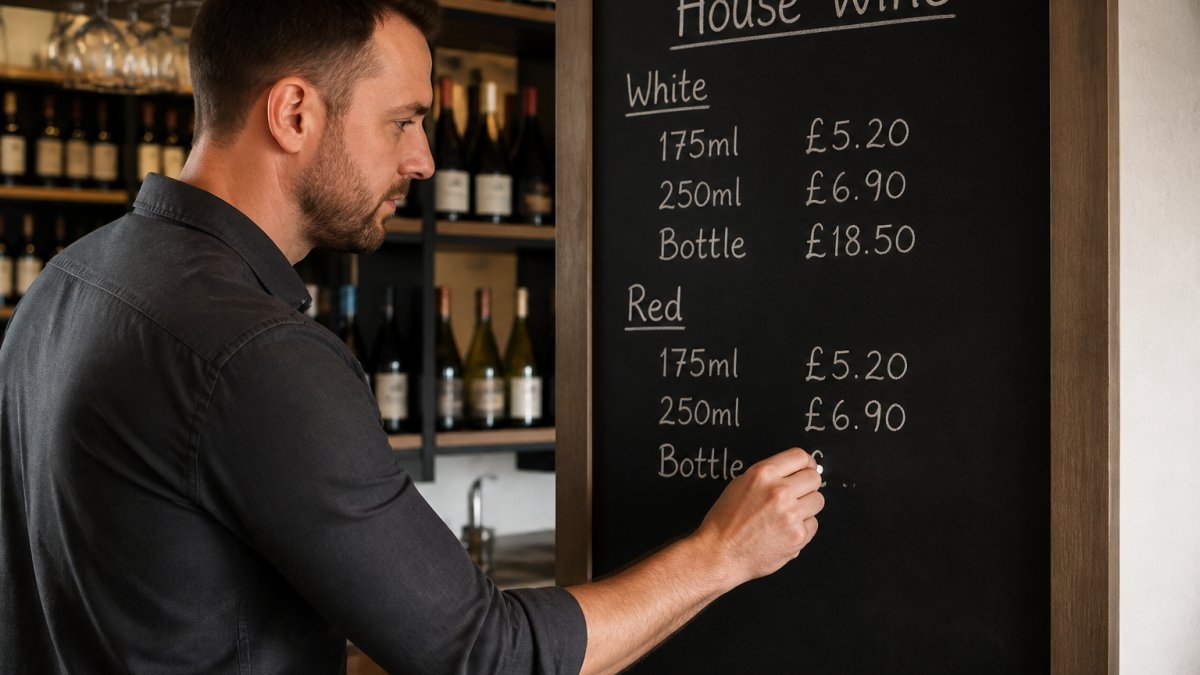
The tension here is real. Lower prices drive volume. Higher prices drive margin per bottle. You need both.
One approach is to offer a tiered house wine list: an entry-level house wine at a lower price point to capture price-sensitive guests, and a premium house option at a higher price to capture guests willing to spend more.
This works because it segments demand. Budget-conscious guests feel they've got a good deal. Guests with higher budgets get what they want. You capture margin from both.
The entry-level house wine should still hit your target margin. Don't sacrifice profitability just to compete on price.
This is where most venues leak money without realising it. Inconsistent pour sizes destroy your margin faster than almost anything else.
A standard wine glass is 175ml. Many venues pour 200ml or more, either through inconsistent technique or generous staff.
A 75cl bottle yields approximately 4.3 standard 175ml glasses.
Over a year, with even modest sales volumes, that's thousands of pounds lost.
The fix is mechanical: use a wine pourer with a built-in measure, or train staff to use a jigger. It takes 10 seconds per pour. It transforms your margin.
Track your actual bottle yield weekly. If you're supposed to get 4.3 glasses per bottle and you're only getting 3.8, you've got a pour-control problem. Fix it immediately.
Wastage happens. Glasses break. Wine spills. Guests leave half-full glasses. You can't eliminate it, but you can measure it and keep it under control.
Many venues don't track wastage at all. They assume it's negligible. Then they're shocked when the numbers don't add up.
Set a wastage budget and measure actual wastage monthly. If you're above your target, investigate. Is it spillage during service? Breakage in storage? Over-pouring? Each has a different solution.
Breakage is often the biggest culprit. Proper glassware storage, careful handling during service, and adequate space behind the bar all reduce breakage. It's worth investing in.
Your house wine choice affects both margin and customer satisfaction. Pick the wrong wine and you'll either sacrifice margin or lose guests.
The best house wine is one that:
If you're a gastropub, your house wine should feel premium. If you're a high-street pub, it should be accessible and reliable. Match the wine to your venue.
Work with a supplier who understands this. Not all suppliers do. Some will push you toward the cheapest option. Others will recommend wines that don't suit your market.
At Swallow Drinks, we've spent 40 years building relationships with venues across the region. We know what works in different settings. Our house wine selection, including options like our House Pinot Grigio at £6.99 and House Merlot at £6.99, is chosen specifically for venues that need reliable, profitable stock.
Your supplier matters more than most venue owners realise. A good supplier delivers consistently, offers competitive pricing, and helps you think strategically about your wine programme.
A bad supplier leaves you short on busy nights, charges unpredictable prices, and treats you like a transaction rather than a partner.
Look for a supplier who:
These aren't luxuries. They're basics. If your current supplier doesn't tick these boxes, it's worth exploring alternatives. The cost of running out of house wine on a Saturday night, or being locked into a contract with poor terms, far outweighs the hassle of switching.
Managing your wine stock is about forecasting demand, controlling cash flow, and tracking what's actually selling.
Most venues order wine reactively: they run low, they order more. That approach costs money.
Better venues forecast. They look at historical sales patterns, upcoming events, and seasonal trends. They order ahead, which lets them negotiate better pricing with suppliers and avoid emergency orders at premium rates.
Forecasting also helps with cash flow. If you know you'll sell 20 bottles of house wine this week, you can plan your cash position accordingly. You're not surprised by large orders.
Start simple. Track how many bottles of each house wine you sell each week for eight weeks. You'll see patterns. Use those patterns to forecast the next four weeks. Adjust as you go.
Not all house wines perform equally. One might sell three bottles a week. Another might sell ten. Yet you're stocking both equally.
Track sales by wine weekly. Identify your top performers. Double down on those. Consider discontinuing wines that don't move.
This isn't about chasing trends. It's about aligning your stock with actual demand. When you do, you reduce dead stock, free up cash, and improve your overall margin.
Many venues also find it helpful to track sales by time of day or day of week. Your house red might outsell your house white on Friday nights but underperform on Tuesday lunchtimes. Adjust your recommendations accordingly.
Improving profit margins on house wine comes down to execution. Here are the strategies that work.
Your wine list design affects sales and margin. A well-designed list guides guests toward your highest-margin wines. A poorly designed list leaves money on the table.
Start with positioning. Put your house wines at the top of the list, in a dedicated section. Make them easy to find. Don't bury them among premium options.
Use descriptive language. "Crisp, dry white" outsells "white wine." Guests want to know what they're getting. Good descriptions increase confidence and sales.
Train your staff to recommend house wines. Most guests don't know what they want.
Incentivise your team. Many venues offer staff a small bonus for house wine sales. It works. Suddenly, your team remembers to recommend house wine instead of premium options.
Your supplier relationship is a negotiation. Most venue owners treat it as fixed. It isn't.
If you're buying consistent volume, you have use. Use it. Negotiate on price, delivery terms, and payment terms.
Ask your supplier:
A good supplier will say yes to most of these. If yours won't, you've got a problem.
Also, consider buying direct from a specialist wholesaler rather than a general supplier. Specialists often have deeper expertise. They understand the on-trade sector.
At Swallow Drinks, we work with venue owners to understand their specific needs. We offer flexible ordering through our trade ordering platform, competitive pricing on consistent volume, and regular delivery.
Improving profit margins on house wine isn't about gimmicks or aggressive pricing.
Most restaurants apply a markup of 200-300% on house wine, meaning a bottle that costs £7 might be sold for £18-21. This accounts for operating costs, staff wages, and profit. However, by the glass, margins can be higher because you're selling smaller portions from each bottle. The key is calculating your exact cost per pour and setting prices that cover your overheads while remaining attractive to customers.
Improving profit margins on house wine involves three actions: first, negotiate better purchasing prices with your supplier by committing to regular orders; second, control portion sizes strictly so you maximise the number of glasses per bottle; third, price strategically by testing what your customers will pay without losing sales volume. Track which wines sell best and focus stock on high-margin selections. Working with an experienced supplier like Swallow Drinks, with 40 years in the industry, ensures you're getting competitive pricing and expert guidance on stock selection.
Using calibrated pourers and training staff on consistent serving sizes ensures you hit your target number of pours every time. This directly increases revenue without raising prices. Combined with accurate costing, portion control can improve margins across your wine programme.
House wine is essential because it drives volume and cash flow. Customers order it by the glass, which generates more revenue per bottle than selling whole bottles of premium wines. The strategy is to stock a quality house wine at a competitive price (such as Swallow Drinks' House Pinot Grigio or House Merlot) alongside 2-3 premium options. This mix maximises both profitability and customer satisfaction. House wine builds loyalty through good value, while premium selections capture customers willing to spend more.
Members of:


AWRS Registration Number: XJAW00000100730