Oct 14, 2026
Last Updated: October 13, 2026
Improving delivery logistics starts with honest assessment: know what's working before you fix anything.
Track three core metrics over four weeks. Record every delivery: what arrived, when, what was missing or damaged, and how it affected service.
Most venues find their biggest problems here: late Tuesday deliveries, incomplete orders, or a receiving team that can't process stock fast enough at peak times.
Document everything in a simple spreadsheet or notebook, answering these questions:
The ones that succeed measure first.
Once you've identified your baseline, hospitality stock management becomes your priority, not expensive software, but a system that works for your venue.
A proper approach tracks three things: what you have, what you've ordered, and when it arrives. Most independent venues rely on memory or gut feel, that's where problems start.
Set up a basic system with whatever tool works for your team, spreadsheet, notebook or simple app.
If you run a busy pub, your par level for lager might be 40 cases. When you hit 40, reorder immediately, this prevents stockouts without tying up cash in excess stock.
Review stock levels weekly and adjust par levels for seasonal demand and upcoming events.
Consistency transforms hospitality delivery logistics. Predictable supplier schedules make your operation easier to plan.
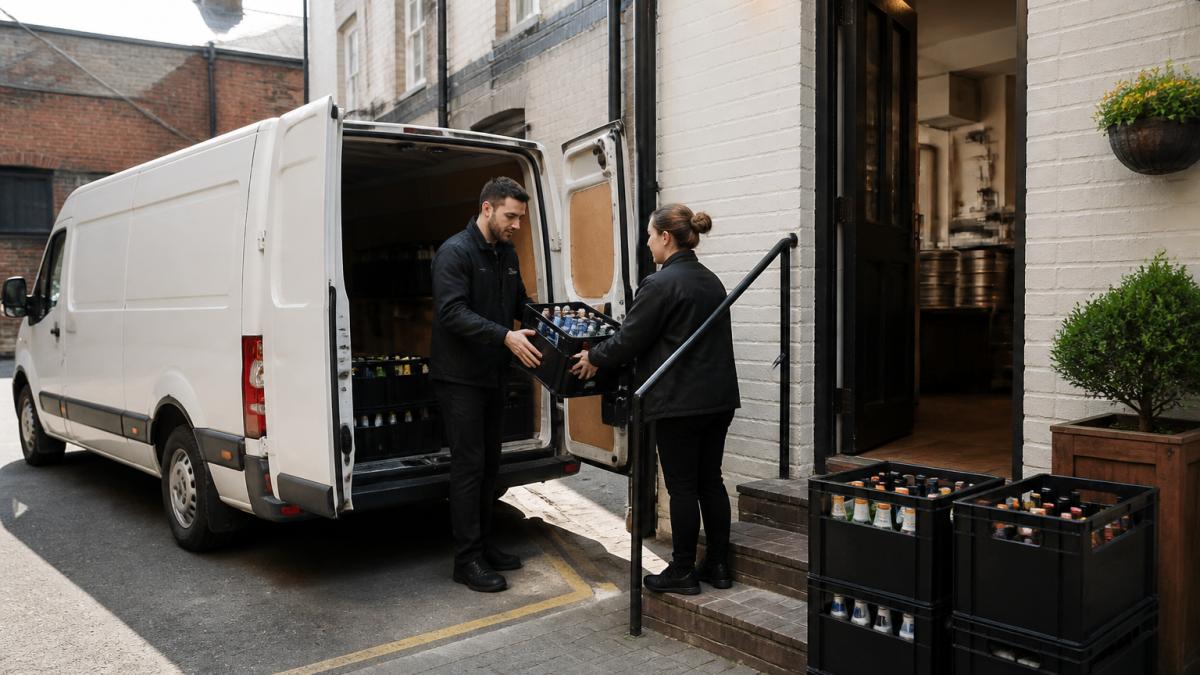
Work with your suppliers to establish fixed delivery days and time windows.
Communicate your receiving capacity. If your team can only process one delivery between lunch and dinner service, say so. Good suppliers will work around your constraints.
Swallow Drinks operates six-day delivery across the region specifically because hospitality venues need flexibility. We understand that Saturday stockouts damage your Saturday night.
Document your agreed delivery schedule in writing and share it with your team.
A drinks ordering checklist prevents the most common mistakes: forgetting items, over-ordering slow movers, or running out of popular lines.
Build your checklist around your actual menu and customer preferences, including every spirit, beer, wine and soft drink you stock, with quantity targets based on par levels and upcoming events.
Review it before every order, five minutes that saves hours of disruption.
Your checklist should include:
Print it or save it on your phone and use it every ordering cycle.
When you order from Swallow Drinks, our team can help refine your checklist based on what works for similar venues.
Seasonal demand swings hit hospitality hard. Summer garden parties need different stock than winter nights by the fire, and Christmas demands planning months ahead.
Anticipate these swings three months ahead. If July brings garden functions, order extra stock in June; if December is your busiest month, confirm supplier capacity in September.
Managing seasonal demand in hospitality requires honest forecasting. Look at last year's sales: more prosecco in summer? More whisky in winter? Build your ordering around these patterns.
Create a seasonal calendar. Mark peak periods, holidays, and events, and share it with your supplier so they can prepare.
Stock moves differently by season. A spirits-focused bar might overstock gin in December only to find it sits through January.
Delays and disruptions create chaos: a missing spirit on Saturday night costs revenue, a damaged case of wine forces a scramble for replacements. The venues that handle disruption best have the strongest receiving operations and contingency plans.
Your back-of-house receiving area is where delivery logistics succeed or fail. Most venues treat it as an afterthought, then wonder why stock goes missing or spoils.
Start with a delivery appointment system: give each supplier a fixed window, such as Monday and Thursday, 10am to noon. This prevents three vans arriving at once and lets you plan staff around known delivery times.
Assess your physical constraints honestly:
A simple receiving checklist prevents most disputes. Before the driver leaves, confirm case counts match the delivery note, no visible packaging damage, chilled and frozen items are still at temperature, and any shortages or damage are noted and countersigned.
Even the best suppliers face weather, transport disruption, and sudden demand. A contingency plan keeps service running when things go wrong.
Identify your critical lines, the products you cannot serve without, such as a pub's best-selling lager and house spirits or a restaurant's signature wine.
Keep a written contingency list with contact details, updated quarterly. When a delay happens, you want to act, not search.
For seasonal peaks, bank holidays, Christmas, summer events, confirm supplier capacity at least three months ahead and ask about their own contingency plans. A supplier who cannot explain how they handle a transport breakdown is a risk.
Delivery efficiency and food safety are not separate concerns. Under UK food safety law, you are responsible for ensuring that food and drink you receive is safe and fit for purpose, temperature control, chain of custody, and documentation.
For chilled and frozen deliveries, check temperatures on arrival with a probe thermometer (chilled at or below 8°C, frozen solidly frozen), record the temperature and time of check, and reject or note out-of-range deliveries for immediate use.
For ambient stock, spirits, wines, soft drinks, check for damaged packaging, broken seals or signs of tampering.
If dinner service starts at 6pm, all stock must be processed by 5pm, so deliveries must arrive by 3pm at the latest. Communicate this deadline to suppliers and build your schedule around it.
When delays happen, and they will, know which nearby venues or suppliers can provide emergency stock, and keep contact details handy.
Most delivery disruptions are preventable: communication breaks down or standards slip. Tighten both.
Swallow Drinks operates six-day delivery across the region specifically because hospitality venues need flexibility. We understand that Saturday stockouts damage your Saturday night. We have built our logistics around your schedule, not the other way around. Our team can also help you set up receiving checklists and contingency plans that work for your venue. Register for our trade ordering platform at webtrade.swallow.uk.com to simplify your purchasing and access our full range.
You cannot improve what you do not measure. Once your systems are in place, measure performance regularly, but measurement without a scorecard and review routine is just data collection.
Track these six metrics every month in a simple spreadsheet or notebook. The goal is to spot trends, not create paperwork.
| Metric | What to measure | How to calculate | Target |
|---|---|---|---|
| On-time-in-full (OTIF) | Deliveries arriving within the agreed window and complete | (On-time and complete deliveries ÷ total deliveries) × 100 | 95% or higher |
| Order accuracy | Items received match items ordered | (Correct lines ÷ total lines) × 100 | 98% or higher |
| Spoilage or damage rate | Stock unusable due to damage or temperature failure | (Damaged or spoiled items ÷ total items received) × 100 | Below 2% |
| Cost per delivery | Total delivery cost (including staff time) ÷ number of deliveries | Total cost ÷ deliveries | Track trend, aim to reduce |
| Receiving time | Minutes from van arrival to stock put away | Average over the month | Under 30 minutes for a standard drop |
| Stockout frequency | Number of times key items run out | Count per month | Zero for critical lines |
These targets are starting points. A busy city-centre restaurant might aim for 98% OTIF; a rural pub with fewer deliveries might accept 90% if the supplier is otherwise reliable.
Review your scorecard monthly with your team and ask three questions: which metric is furthest from target; what is causing the gap (one supplier or all of them? staffing or layout?); and what one specific change will we make, such as asking Supplier A to deliver between 8am and 10am instead of 10am and noon.
Share the scorecard with your suppliers. Data-backed conversations are harder to ignore. If on-time delivery drops below 90%, raise it. If damaged goods exceed 5%, request better packaging. If order accuracy is poor, ask for a review of their picking process.
After three months of scorecard data, use the patterns to optimise: consolidate deliveries where two suppliers share a day; adjust par levels if stockouts and spoilage are both high; renegotiate terms with consistently underperforming suppliers; and train your team or reorganise storage if receiving time is long.
You do not need expensive software to run a scorecard. A spreadsheet works. But if you want to automate, look for tools that integrate with your ordering and stock systems. The key is consistency, not sophistication.
Swallow Drinks works with venues that measure their performance. When you track what matters, we can help you improve it. Our team uses your data to refine our delivery schedules and stock planning.
Ready to transform your delivery logistics? Explore our full range of premium drinks and ordering options, or register for our trade ordering platform to simplify your purchasing. Let us build a system that works for your venue.
Start by auditing your current performance against on-time delivery targets, then align your supplier delivery schedules with your peak trading times. Implement a drinks ordering checklist to prevent stock-outs, use hospitality stock management tools to track levels in real time, and establish clear communication protocols with your supplier. Most venues see measurable improvement within four weeks of systematic tracking.
Seek a supplier who offers consistent delivery windows that match your operating hours, provides visibility into order status, and demonstrates flexibility during seasonal peaks. Reliability matters more than price alone, a supplier who delivers on six-day schedules without gaps protects your guest experience and reduces emergency orders. Look for partners with experience serving hospitality venues and willingness to consult on your menu and stock mix.
Track historical sales data by season and day of week to forecast demand patterns. Increase stock levels 2-3 weeks before peak periods such as Christmas, summer holidays, and bank holidays. Communicate forecast changes to your supplier early and agree on flexible delivery quantities. Adjust your drinks ordering checklist seasonally and review stock turnover monthly to avoid tying up cash in slow-moving lines.
Establish a fixed delivery schedule that aligns with your trading patterns, for example, mid-week and weekend deliveries for high-volume venues. Use hospitality stock management to set par levels for each product based on usage rates. Coordinate receiving times with your back-of-house team to ensure stock is checked and stored immediately. Regular communication with your supplier about upcoming events or menu changes prevents misalignment.
Members of:


AWRS Registration Number: XJAW00000100730